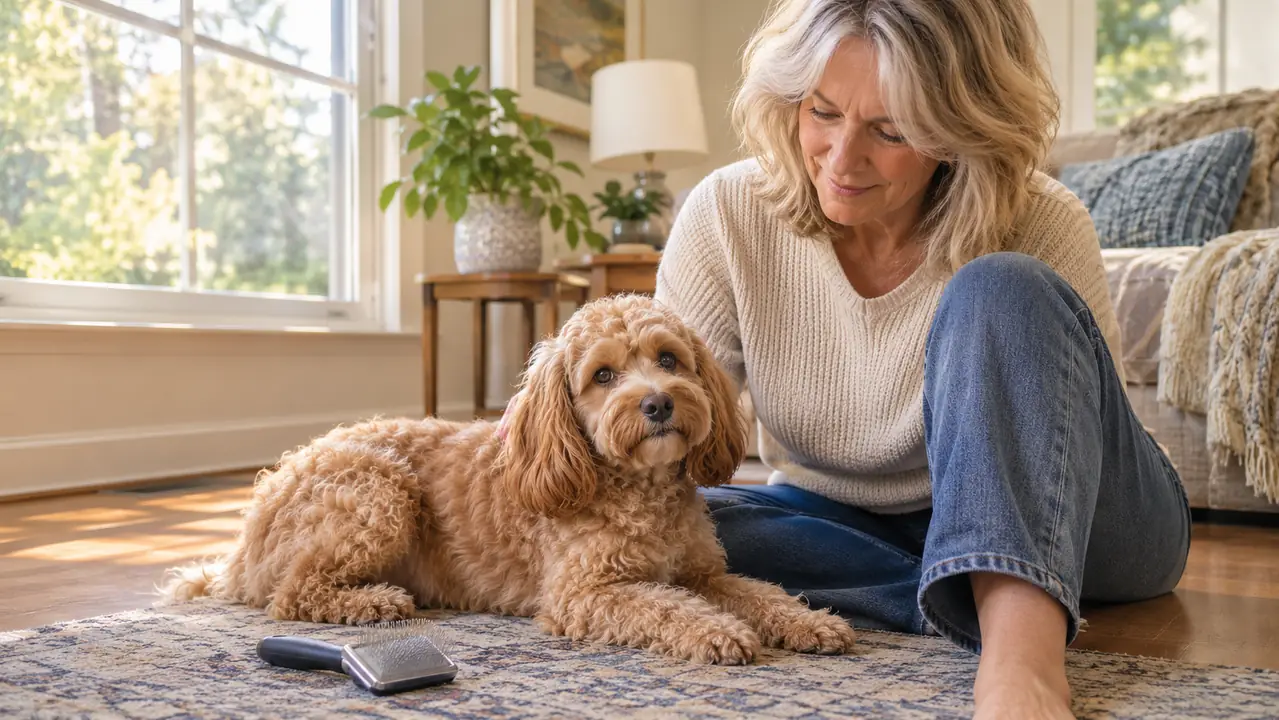
I bought the Coastal Pet Li'l Pals slicker brush in September 2025 because Dana, our groomer, told me the pin brush I had used since Wally was a puppy was not reaching the mats behind his ears. Wally is a 4-year-old Cavapoo, 16 pounds, apricot curls, long floppy ears. He is my only dog and my first small dog. I am 59, retired from school office work, and I live outside Roanoke, Virginia, with my husband Tom. We have hardwood floors, a small fenced backyard, and no stairs inside the house. Two low steps at the back door are the only ones he uses. That matters because this is a small-brush review from a small-dog house, not a grooming salon.
Here is the short version. The Li'l Pals brush is a small slicker brush with flexible wire pins and plastic tips. The listing says it detangles fur, removes loose hair, and smooths the coat. It measures 3.25 by 7.25 inches and weighs 0.96 ounces. It helped with the mats that form behind Wally's ears and in his armpits. It did not replace Dana, it did not remove a tight mat, and it is not the right brush for a big dog. I have owned it about 14 months. For a dog Wally's size, I would buy it again. That is the honest review in one paragraph.
The Quick Verdict
A small, light slicker brush that earns its place in a 16 pound dog's coat routine, as long as you know it is maintenance, not mat removal.
Amazon Check Today's Price →If your small dog mats behind the ears, start with a brush that fits the job
The Coastal Pet Li'l Pals slicker has flexible wire pins with plastic tips and a 3.25 by 7.25 inch head. It is the brush I reach for every Sunday before ear cleaning. It will not replace your groomer, but it will make the six weeks between visits easier.
Amazon Check Today's Price on Amazon →What the Li'l Pals Brush Actually Is
It is a plain tool. The head is rectangular, the handle is plastic, and the pins are wire with plastic tips. The listing calls the pins flexible, and that is what lets them move over a curled coat instead of skidding across the top. The whole brush weighs 0.96 ounces, which is light enough to hold for 15 minutes without thinking about it. The head is 3.25 by 7.25 inches. On a 16 pound dog, that is a good size. On a Labrador, it would be a detail brush.
The listing says it is for detangling, all hair lengths, and that the plastic tips will not irritate sensitive skin. I can speak to the detangling and the tips. Wally has a curly coat that mats in two places: behind the ears and in the armpits. The plastic tips do not scratch him when I use light strokes. The wire pins will scrape if I press, and I learned that the first week. The brush is not a one-step groom. It is a maintenance brush, and the comb does the checking.
One thing to be clear about: this is not a brush with a button, a retracting pin pad, or a self-cleaning feature. The specs do not list any of that, and the brush does not have it. It is wire pins set in a rectangular head with a plastic handle. That simplicity is why it is light and easy to keep in a kitchen drawer. It is also why you have to clean the pins yourself with a comb or your fingers. If you want a brush that clicks and retracts, this is not that brush.
How I've Used It for 14 Months
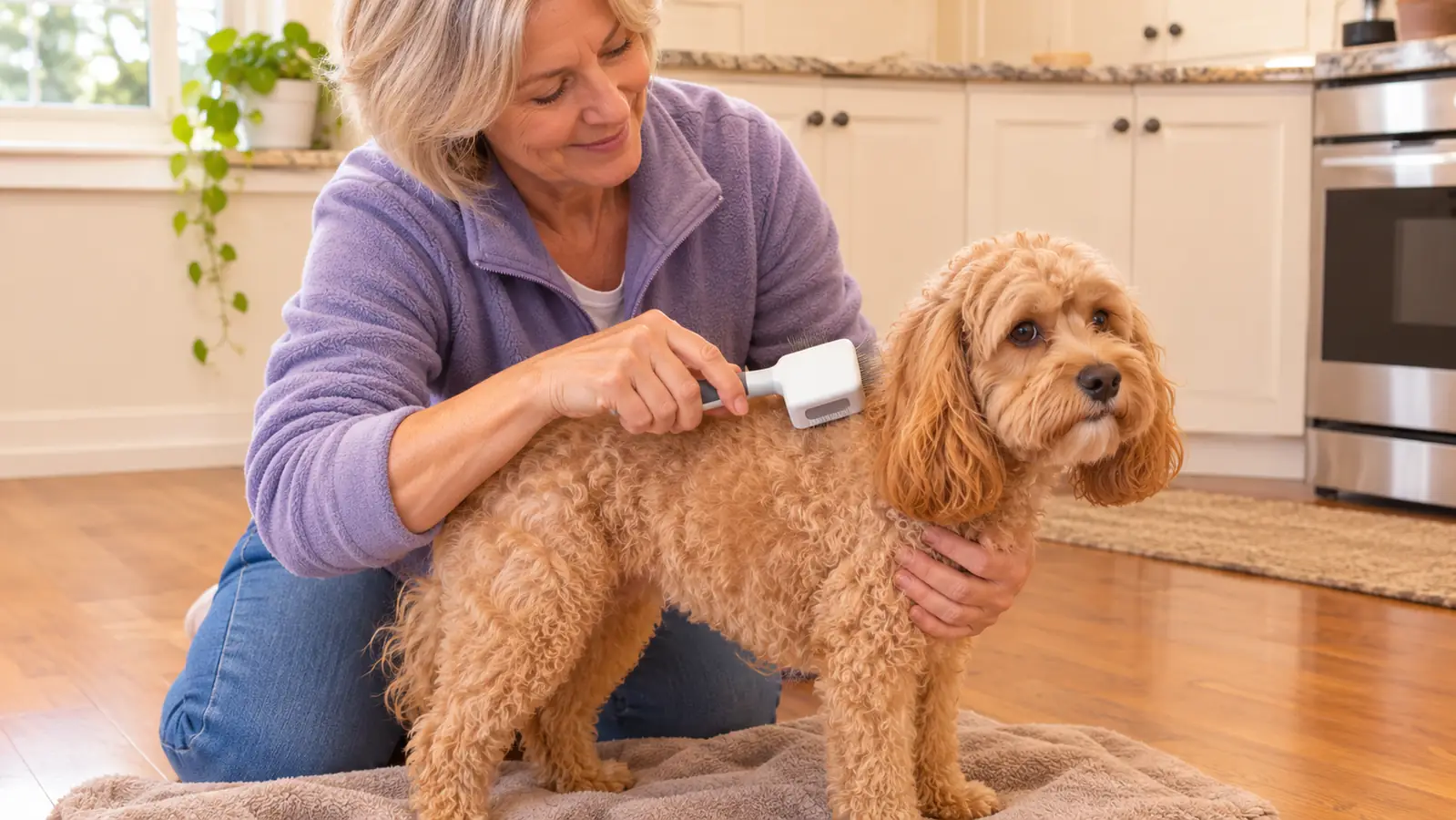
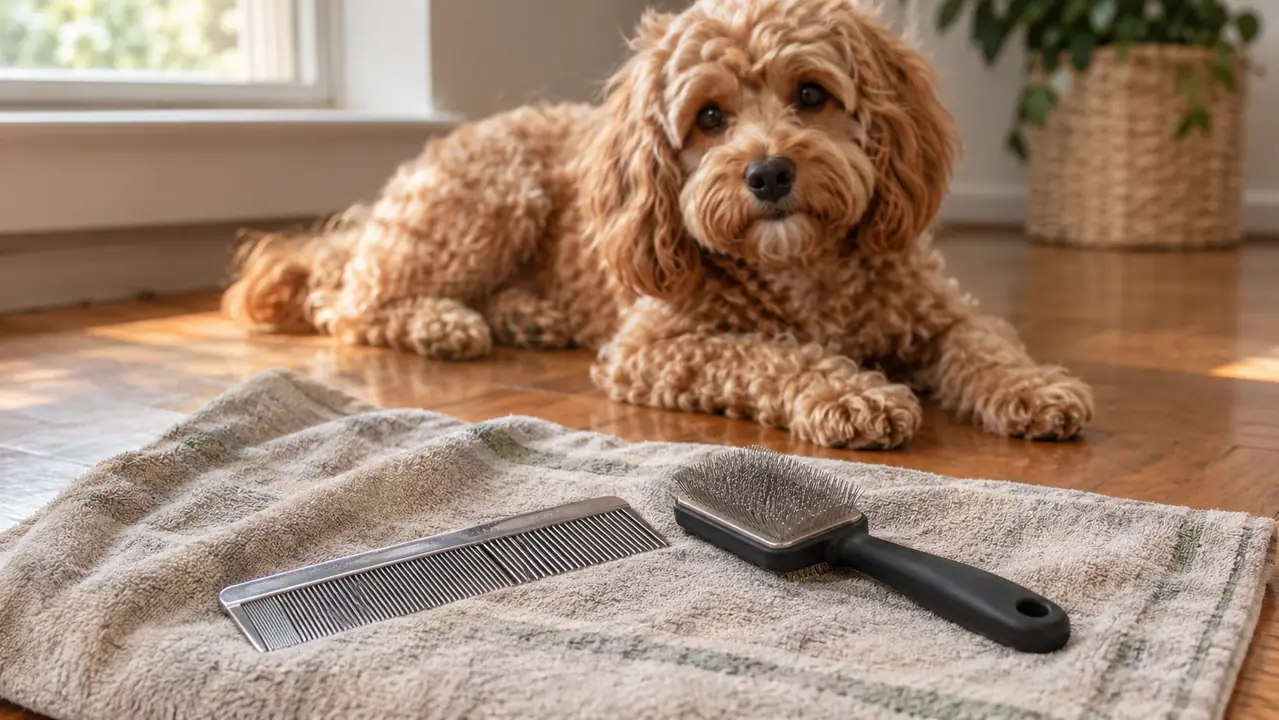
Wally gets a full brush-through every Sunday evening, about 15 minutes, before his ear cleaning. I sit on the floor in the living room with an old towel under him. I start behind his ears, then his armpits, then his back and legs. I use light strokes, section by section, and I follow with a plain steel comb I already owned. The comb tells me whether I actually got through the coat or just smoothed the top. If the comb catches, I go back with the brush. The brush lives in the kitchen drawer by the back door, which is the only reason I use it as often as I do.
On Wednesdays I do a 2-minute check behind the ears and in the armpits. That is not a full groom. It is a feel with my fingers and a few strokes with the brush if I feel a small tangle starting. That Wednesday check is the habit that made the biggest difference. Before I started it, I would find a mat on Sunday and blame the brush. The truth was I was only paying attention once a week. A small mat that gets caught on Wednesday is a five-second fix. A mat that waits until Sunday is a groomer conversation.
Before September 2025 I used the big pin brush from Wally's puppy kit. I had used it since 2022. It was fine when he was a puppy with a softer coat. As his adult curls came in, the pin brush slid over the top. It made the coat look smooth for about an hour. The mats were still there underneath. I did not know that until Dana showed me one behind his left ear. She did not scold me. She just said the pins were too long and too far apart for the job, and suggested a small slicker. That is how the Li'l Pals brush ended up in the kitchen drawer.
I have owned it about 14 months now. It has been dropped, wiped with a damp cloth, and picked up with wet hands. The plastic handle has no cracks. The pins have not bent in a way that matters. The plastic tips are still on. I have not had to replace it. That is not a dramatic endorsement. It is a small tool that has held up to one small dog and a weekly routine. If you groom several dogs a day, you will want something else. For one 16 pound Cavapoo, it has been enough.
By the second groomer visit after I started, about 12 weeks in, Dana stopped mentioning mats. That was the whole test.
What It Fixed and What It Did Not
About five weeks in, the mats behind Wally's ears were smaller. They were not gone. They were smaller and softer, and the comb went through with less tugging. By the second groomer visit after I started, about 12 weeks, Dana stopped mentioning mats. She still trimmed around his ears and did the sanitary trim. She just did not have to spend time working out a mat. That was the result I wanted. It did not happen because of one heroic brushing session. It happened because I brushed the same two spots every week and checked them on Wednesdays.
It did not remove a tight mat. I want to be plain about that because it is the thing that makes people disappointed. If a mat is already tight against the skin, this brush will not dissolve it. The pins will catch on it and pull. Dana removes those with a clipper or a mat splitter when needed. The Li'l Pals brush is for the small tangles that are still loose enough to separate. If you try to brush out a tight mat, you will hurt your dog and blame the brush. That is not the brush's job.
It also did not stop mats from forming. If I skip a Sunday, I can feel the difference by Tuesday. The coat is curly and fine, and it wraps around itself. The brush manages that. It does not change the coat. Wally still mats behind the ears. He still gets little tangles in his armpits where the harness sits. The difference is that they stay small enough to manage at home. The brush buys me time between groomer visits. It does not buy me a free pass.
What It Does Well on a Cavapoo Coat
The small head is the part I did not expect to care about. A bigger brush feels efficient, but on a 16 pound dog it is clumsy around the ears and armpits. The Li'l Pals head fits into those spots without me having to hold Wally's ear out of the way with one hand and brush with the other. I can work around the base of the ear, where the mats start, in short strokes. That is the whole reason Dana suggested it. A slicker brush is only useful if it can reach the spot that mats.
The plastic tips are another quiet plus. Wally is not a dramatic dog, but he will walk away if a brush scratches him. The wire pins with plastic tips let me use light strokes without him flinching. I still have to use light strokes. The tips reduce the scrape, they do not remove it. If you press hard, he will let you know. That is true of every slicker brush I have used. The difference here is that the brush is small enough that I am not dragging it across a big area with too much pressure.
It also does what the listing says about smoothing the coat. After a Sunday session, Wally looks tidier. The curls sit together instead of sticking out in different directions. That lasts until he goes outside and rolls on the rug. I do not expect a show finish. I expect him to look cared for and to be comfortable. The brush does that. It also removes loose hair, which I see on the towel. Less loose hair on the towel is less loose hair on the couch. That is a small thing, but it is the kind of small thing that matters in a house.
The Parts Nobody Mentions
The wire pins can scrape if you press. I said it once and I will say it again because it is the main complaint I would have. The plastic tips help, but they do not make the brush soft. If you bear down on a tangle, Wally will pull away. The fix is not a different brush. The fix is lighter strokes and more sessions. I use the brush like I am smoothing a shirt, not like I am scrubbing a floor. When I do that, he lies still. When I forget, he gets up and leaves.
The brush is small, which is good for a small dog and bad for a big job. A full brush-through on Wally takes about 15 minutes. On a 60 pound dog, it would take forever. The head is 3.25 by 7.25 inches, and that is not enough surface for a large coat. If you have a Labrador or a goldendoodle, this is not your main brush. It might be a detail brush for the face and feet, but I would not buy it as the only brush for a big dog. The listing says small breeds and puppies, and that is accurate.
The handle is plastic and plain. It does not have a padded grip. It does not have a strap. It is light, and that is the trade. I can hold it for 15 minutes without a problem. If you need a thicker handle, this will feel thin. I would rather have the light weight than a padded handle that makes the brush heavier. That is a personal preference, not a defect. It is worth knowing before you buy.
How It Compares to the Pin Brush I Used Before
The pin brush was bigger and had longer pins. It was the right brush for a puppy coat. It was the wrong brush for Wally's adult curls. The pins slid over the top and left the mats underneath. The Coastal Pet Li'l Pals brush has shorter wire pins with plastic tips, and the head is small enough to work in sections. I am not saying the pin brush is bad. I am saying it was doing a different job. If your Cavapoo has a wavy coat with no mats, a pin brush might be all you need. If your dog mats behind the ears, the slicker is the better tool.
I still use the pin brush on Wally's tail and back legs sometimes, because it is faster on the parts that do not mat. The Li'l Pals brush does the detail work. The comb does the checking. That is a three-tool routine, and it sounds like more than it is. The brush is the one I would replace first if it broke. The pin brush could go. That tells you what I think of the Li'l Pals brush after 14 months. It is not the only tool, but it is the one doing the job the others cannot.
What I Liked
- Small head reaches behind the ears and into the armpits
- Wire pins with plastic tips are gentle with light strokes
- Weighs 0.96 ounces and is easy to hold for 15 minutes
- Helped shrink mats by about five weeks
- Simple plastic handle and no extra parts to break
Where It Falls Short
- Too small for a large dog
- Wire pins can scrape if you press
- Will not remove a tight mat
- Plastic handle is plain and thin
- Needs a weekly routine to work
Who This Is For
This is for someone with a small dog or a puppy, especially a dog with a curly or wavy coat that mats in small spots. Cavapoo, Cockapoo, Maltipoo, Havanese, and poodle crosses are the obvious fits. It is also for someone who already has a groomer and wants to keep the coat manageable between visits. If you are brushing a 16 pound dog once a week and checking behind the ears midweek, this brush will earn its place. It is not a professional tool, but it is a good home tool.
It is also for someone who has been using a bigger pin brush and wondering why the mats keep coming back. That was me. The pin brush made the coat look smooth. The slicker brush got under the top layer. If you are not sure which brush you need, start with the small spots that mat. If the mats are behind the ears and in the armpits, a small slicker is the right shape. If your dog has a long, straight coat with no mats, you probably do not need this.
Who Should Skip It
Skip it if you have a large dog. The head is too small for a big coat. You will spend twice as long and get half the result. Skip it if your dog already has tight mats. This brush will not remove them, and it can hurt if you try. Those mats need a groomer or a vet, not a brush from a kitchen drawer. Skip it if you want one tool that does everything. This is a detail brush. It is not a dematter, a clipper, or a replacement for Dana.
Skip it if you want a brush with a button, a retracting pad, or a self-cleaning feature. The Li'l Pals brush does not have those things. It is a simple slicker with wire pins and plastic tips. That is enough for me. If you need a brush that cleans itself, this will feel basic. I would rather have basic and light than complicated and heavy. But that is my preference, and you should buy for yours. The brush is honest about what it is. It is a small maintenance tool for a small dog.
A small brush for the two spots your Cavapoo actually mats
The Coastal Pet Li'l Pals slicker is not a groomer replacement and it is not a mat remover. It is the 0.96 ounce brush I use every Sunday behind the ears and in the armpits. If that is the job you need done, it is worth a look.
Amazon Check Today's Price on Amazon →