
Wally has a coat that looks like it should be easy. Apricot curls, maybe an inch long, soft to the touch. Then you slide your hand behind his ear and find a knot the size of a pea that was not there on Sunday.
For three years I brushed that coat with the pin brush that came in his puppy kit. It glided along the top of the curls and came away furred, which made it look like it had done something. It had not. Mats on a Cavapoo form behind the ears and in the armpits, underneath the top layer, where long stiff pins never quite arrive. In September 2025 Dana, who has groomed Wally every six weeks since he was about a year old, told me to stop using it and get a slicker brush instead. She did not name a brand. I bought the Coastal Pet Li'l Pals Slicker Brush because the head was small enough for a 16 pound dog and the pins had coated tips. Fourteen months later it lives in the kitchen drawer by the back door.
The Quick Verdict
A small slicker with coated wire pins that finally gets under a curly coat instead of skating over it. Fourteen months of Sundays on a 16 pound Cavapoo, and the mats behind his ears are smaller, not gone. It will not break up a tight mat and it will not replace your groomer, and it does not pretend to.
Amazon Check Today's Price →The fifteen minutes that decides whether your dog sees the groomer with mats or without
A small head, coated wire pins, and enough flex to follow the shape of a 16 pound dog instead of skating over the curls. It is the tool Dana told me to buy, and after fourteen months of weekly use it has not needed replacing.
Amazon Check Today's Price on Amazon →How I've Used It
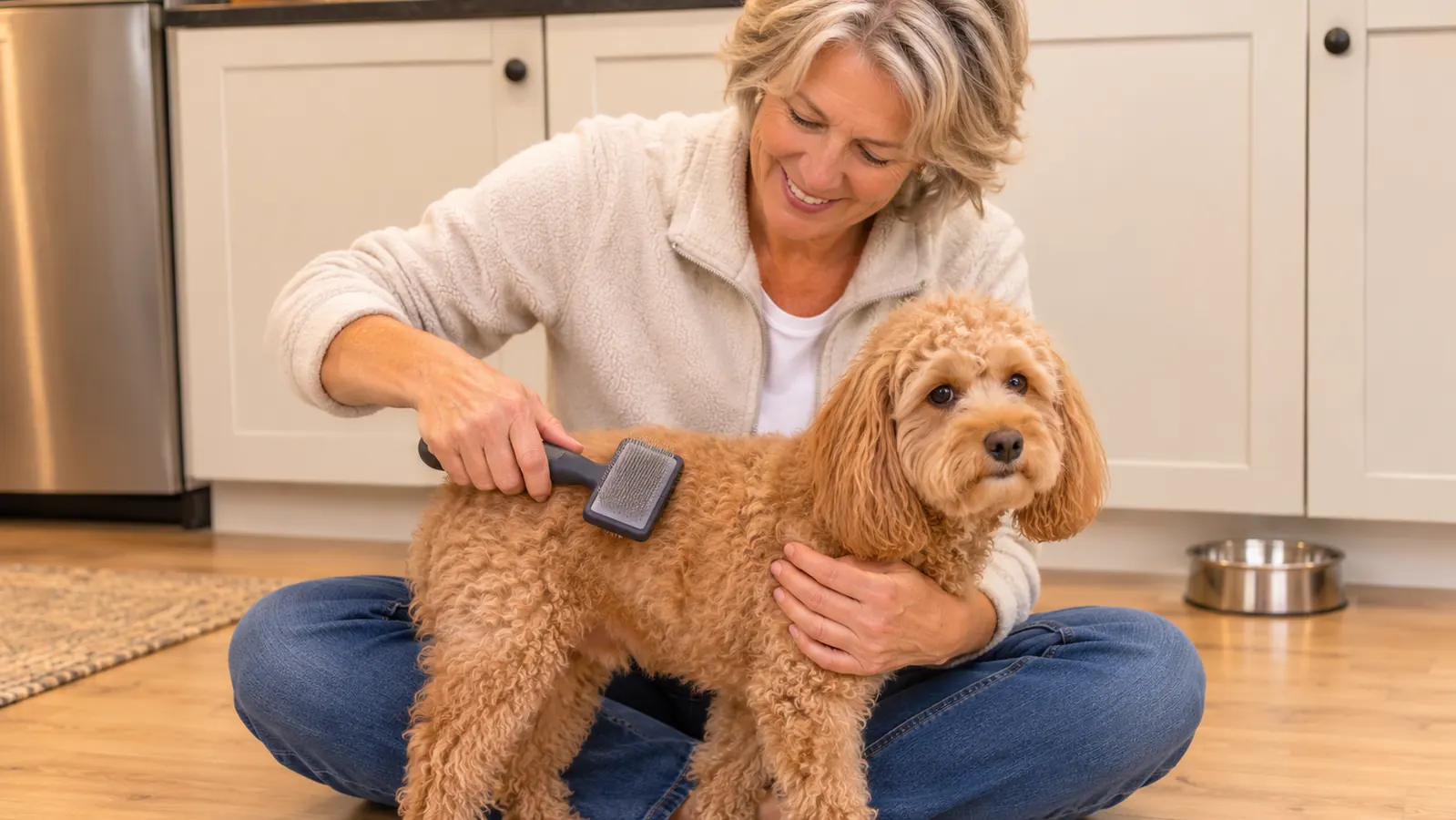
Every Sunday evening, before the ear cleaning, I sit on the kitchen floor with Wally between my knees and the brush in my right hand. Fifteen minutes, section by section: the back first, then each side, then the chest, then the legs, then the places he would rather I skipped. He tolerates it. He does not love it. About ten minutes in he puts one paw on my wrist, which is his way of asking how much longer this is going to take.
The technique matters more than the tool, and I got it wrong for the first month. You do not press. The pins on this brush are wire, thin enough to flex, and if you push down hard the tips drag along the skin and Wally flinches away. Light strokes, a few inches at a time, letting the pins find their own way down to the skin. When I do it that way he stands still and lets me work. When I rush it, he does not, and I have learned to take the hint.
For the first three weeks I used it on a dry coat, which was a mistake I only learned about later. Wally's curls brush out easier if I have run my damp hands over him first, not soaked, just enough to take the static out. Nobody told me that. I worked it out on a rainy Tuesday in October when he came in from the yard already a little damp and the brush went through him in a way it never had before. Now I do it that way every week, and it saves me a couple of minutes and a good deal of his patience.
On Wednesdays I do a two minute check. Behind the ears first, because that is where his coat fails fastest, then the armpits, then a quick pass over the chest where the harness sits during walks. If I find something soft I brush it out. If I find something hard I leave it alone and mention it to Dana, because digging at a tight mat with a slicker is how you end up with a sore dog and an unnecessary trip to the vet.
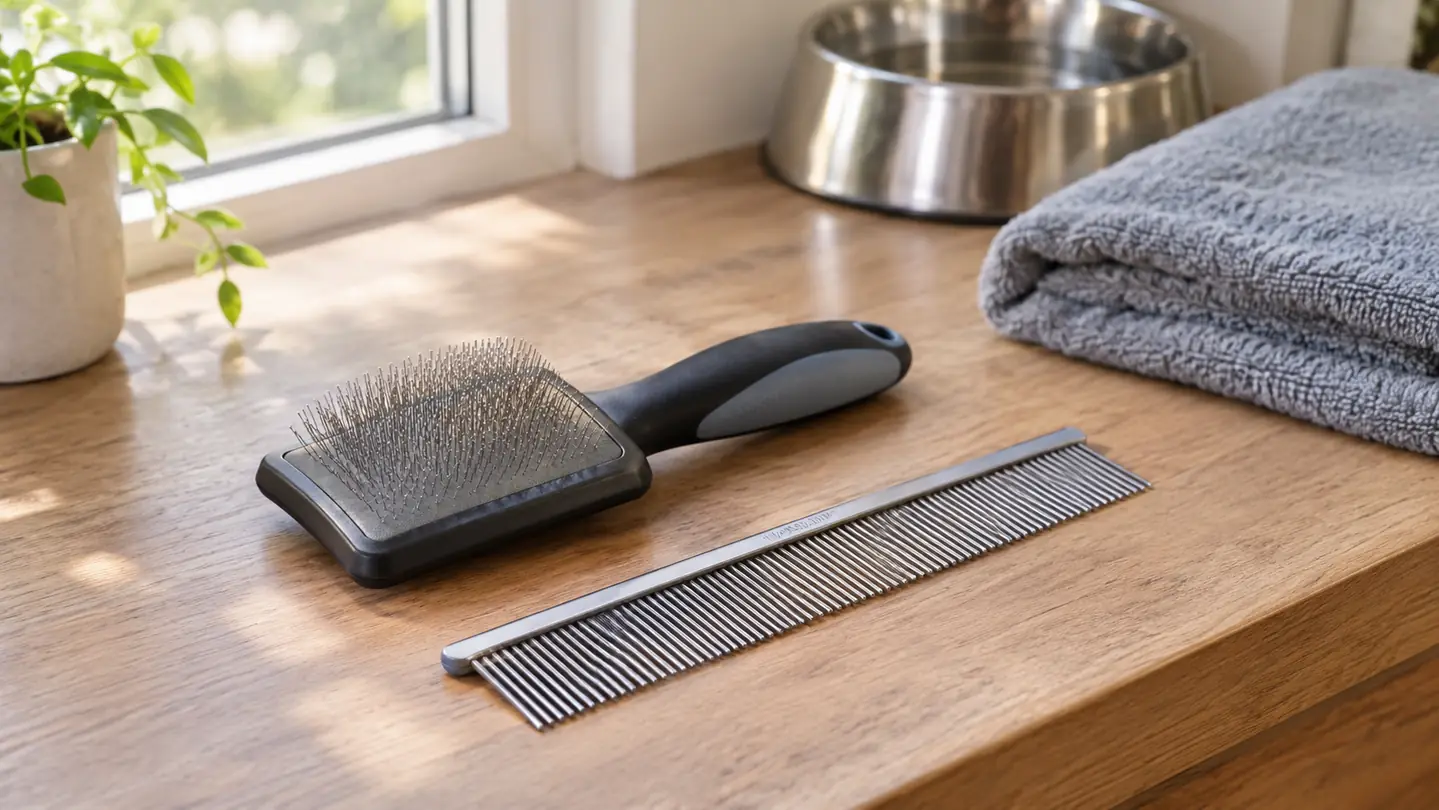
After the brush I run a plain steel comb through the same sections. I have had that comb since the puppy kit. It has no brand on it that I can find and it is not fancy, and it tells me the truth. If the comb passes through without catching, the brushing worked. If it snags, I missed a spot and I go back over it. The brush loosens. The comb checks. I would not want to do one without the other.
One thing I did not expect: the brush has made the Sunday session shorter, not longer. With the pin brush I used to go over him for twenty minutes and still find mats on Wednesday. Fifteen minutes with a tool that actually reaches the undercoat does more than twenty five minutes with one that does not, which is the least satisfying sentence in this review and also the truest.
What the Brush Actually Is
The head measures 3.25 inches by 7.25 inches, and the whole brush weighs under an ounce, which is why my wrist does not ache after fifteen minutes on the floor. The shape is rectangular. The handle is plastic. The pins are wire, and each one is tipped with plastic so the ends are not sharp against a dog's skin. Coastal Pet describes the pins as flexible, and they are, in the sense that they bend rather than stab when they meet resistance.
That flexibility is the reason it works on a coat like Wally's. A pin brush has long straight pins that stand up off the pad and skate across the surface of a curl. A slicker's pins are shorter, denser and angled, so they get underneath the top layer and lift what is caught there. On a curly coat that difference is the difference between brushing and pretending to brush, and it took me three years and one groomer's comment to understand it.
The pins also sit in a flexible pad rather than a rigid block, so when the brush meets the curve of a ribcage the pad gives a little and the pins stay in contact instead of lifting away. On a flat surface you would never notice. On a dog, where everything is curves, it is the difference between brushing the middle of the back and brushing the sides.
The listing says the brush detangles, removes loose hair, smooths the coat, and helps move the skin's natural oils around. I can vouch for the first three. The oil part I take on faith, although his coat does look better on the Monday after a Sunday brush than it does by Friday, so maybe there is something to it.
One size is the only size. That is worth knowing before you order, because it is the reason this brush suits a small dog and frustrates people with big ones.
Nothing about it feels expensive. The plastic handle is light, the pad is fixed to a rectangular backing, and there is no cushioning beyond what the pins provide. It has held up through fourteen months of weekly use, and nothing has bent or pulled loose that I can see. For a tool that lives in a kitchen drawer, that is enough.
Five Weeks In, Then Twelve
I did not notice anything the first month. That is honest, and it is probably why people give up on a new brush too early. You are brushing the same dog, on the same floor, for the same fifteen minutes, and the coat looks the same afterward.
Around five weeks in I realized that the mats behind his ears were smaller. Not gone. Smaller. Where I had been feeling a knot the size of a fingertip, I was feeling something the size of a pea, and the pea came apart under the comb instead of holding.
An example, because vague claims are easy to make and hard to check. On a Sunday in late October I found a knot behind his left ear that I could feel but not see, tucked under the top layer where the ear leather meets the skull. I worked at it with light strokes for about four minutes and it came apart into loose strands. In September the same knot would have been a hard lump, and I would have left it for Dana. Same spot, same dog, roughly four weeks apart.
The second groomer visit after I started, roughly twelve weeks in, Dana handed him back without saying anything about mats. For three years before that, every single visit had included a sentence about the ears and the armpits. I did not say anything either. I put him in the car and drove home and felt quietly pleased about it the whole way.
That is the whole result. No transformation, no before and after photograph. Just a coat that is easier to stay on top of, and a groomer who has stopped having to fix what I let slide.
Where It Falls Short
It does not remove a tight mat. I want to be clear about that, because the first time I found a real one behind his ear I tried to work it out with this brush, and I made the skin red and Wally yelped. A slicker lifts loose undercoat and separates curls that are just starting to knit. A mat that has already knitted is Dana's job, with clippers, and if your dog has one that is pulling at the skin it is worth a phone call rather than a session on the floor.
A note on the armpits, since that is the other place his coat fails. The brush works there only if he is lying on his side and I lift the front leg out of the way, which he allows for about thirty seconds. After that he pulls the leg back down and I let him. Two short passes a week does more than one long fight, and a brush you have to wrestle a dog for is a brush that ends up in the drawer unused.
The coated tips help, but they do not make the brush soft. Press hard and you will scrape. Wally told me so in the first week by leaving the room, and I have used a lighter hand ever since.
It is small. On a 16 pound dog with a full coat, fifteen minutes is about right. On a Labrador it would take an hour and your hand would cramp before you finished. Coastal Pet builds this for small breeds and puppies, and the size is the point rather than a flaw. But if you are reading this with a 70 pound doodle asleep in the next room, this is the wrong tool for you.
And it does not replace the groomer. Dana still comes every six weeks. She still does the sanitary trim, the nails, the ears, and the parts of the coat I cannot reach or should not attempt. The brush buys me five and a half weeks of decent coat between visits. That is all it buys, and it is worth having.
The Sunday Routine, Start to Finish
The brush is one step in a routine that takes about half an hour and has done more for Wally's coat and ears than anything I did in his first three years. Brush first, fifteen minutes, section by section. Comb through the same sections to check the work. Then the ear cleaning in the laundry room, on an old towel, with the EpiOtic that Dr. Reyes recommended after his infection in April 2025. He shakes it on the wall every single time, and I have stopped being surprised.
Every six weeks, Dana does the rest. I mention the routine because the brush only makes sense inside one. A slicker used once a month on a coat that mats is a slicker that does not do much. Used every week on a coat that is already mostly clear, it keeps the mats from getting started, and that is a different job with a different result.
The brush lives in the kitchen drawer with the comb, next to the pens and the takeout menus. That is deliberate. A grooming tool in a cupboard is a grooming tool I forget about.
What I Liked
- Coated wire pins reach under the top layer of a curly coat instead of skating over it
- Small 3.25 by 7.25 inch head suits a 16 pound dog and does not tire your wrist
- Under an ounce, so fifteen minutes of brushing is comfortable to hold
- Flexible pins follow the shape of the body rather than digging straight in
- The mats behind Wally's ears were measurably smaller by five weeks
- No batteries, no parts to lose, nothing to charge or replace
Where It Falls Short
- Will not break up a tight mat, and trying makes the skin sore
- Pins scrape if you press, so the pressure has to stay light
- Too small to be practical on a medium or large dog
- Plastic handle and light build feel insubstantial in the hand
- One size only, which is the whole limitation in a sentence
The mats behind his ears were smaller at five weeks. By twelve weeks Dana stopped mentioning them. That is the whole review.
Who This Is For
You have a small dog with a coat that mats, and you do the between groomer work yourself. A Cavapoo, a Cockapoo, a Shih Tzu, a Havanese, a miniature poodle. Something in the fifteen to twenty pound range with curls or a soft double coat that knots behind the ears. You want a brush you can keep in a drawer and use for fifteen minutes on a Sunday without making a project of it. You are not expecting it to replace the groomer, and you are willing to use a light hand even when the dog is wriggling.
Who Should Skip It
If your dog is bigger than about 25 pounds, skip it. Not because it will not work, but because it will take too long to be worth doing, and a brush with a larger head does the same job faster. If your dog's coat is already matted to the skin, skip it and call your groomer or your vet, because a brush is not the tool for that. If you want one thing that does the whole job, this is not that thing, and neither is any other single brush. And if you are hoping a new brush will make a dog who hates being brushed suddenly enjoy it, this will not. Wally tolerates it. He does not enjoy it, and I do not think he ever will.
If your dog mats behind the ears, start here
A small head, coated wire pins, and a fifteen minute Sunday habit. It will not replace Dana. It will keep Dana from having to fix what you let slide.
Amazon Check Today's Price on Amazon →