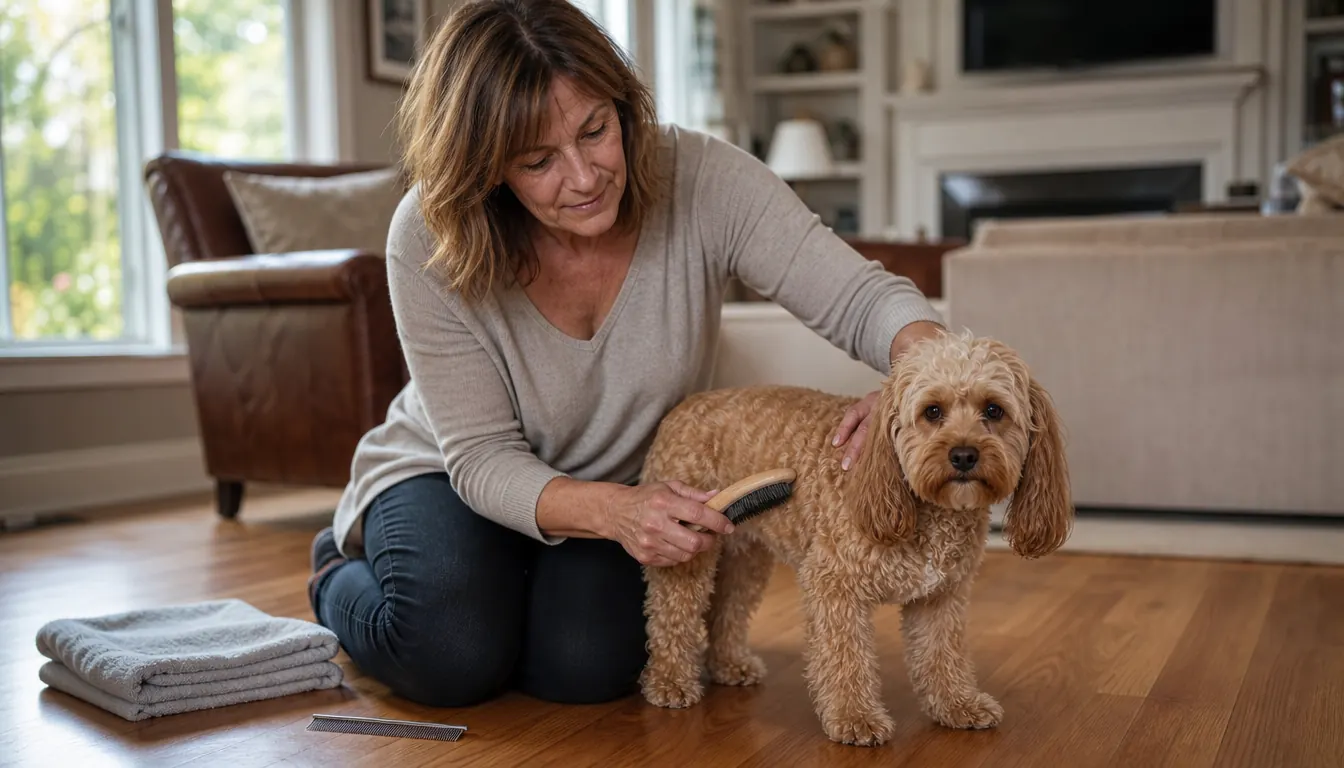
If you own a Cavapoo, you have probably stood in a pet store aisle holding two brushes and wondering which one the dog actually needs. Here is the short answer. For the coat on a Cavalier and Poodle cross, the Coastal Pet Li'l Pals Slicker Brush does the work that keeps mats from forming, and a plain pin brush mostly does not. Not because a pin brush is badly made. Because the two tools are shaped for different jobs, and the job a curly crossbreed coat needs is the one the small slicker brush was built for.
I have used the Li'l Pals slicker for about 14 months. Before that I used the big pin brush that came in my dog's puppy kit from 2022 until September 2025, and I believed I was brushing him properly the whole time. I was not. A pin brush glides across the top of a curl and leaves the mat forming underneath, where you cannot see it until it has tightened into something solid. A slicker brush with flexible wire pins and a plastic tip on each one gets under the curl and lifts the loose hair out. That single difference is the whole argument. Everything below is detail.
The Coat This Is Really About
A Cavapoo coat is not one coat. It is a Poodle coat and a Cavalier coat in the same dog, and which one you get depends on the individual dog. Mine came out curly and thick, with long floppy ears that hang into everything and pick up everything. Curly hair sheds less than straight hair, which sounds like a gift and is actually the problem. The loose hair does not fall out and land on your floor. It wraps around the hair still attached to the dog and tightens.
That is why the brush question matters more with this coat than with most. On a straight-coated dog, a brush is about tidying up. On a curly crossbreed, a brush is about whether the coat stays a coat or turns into felt. Behind the ears and in the armpits are the two places that rub, so those are the two places that mat first, and they are small, awkward spots that a wide brush cannot get into without pushing the dog around.
It cost me about three years to learn that. From 2022 until September 2025 I brushed him twice a week with the pin brush and thought the coat was fine, because from arm's length it looked fine. Then Dana worked a mat apart behind his left ear with her fingers and a comb and told me, plainly, that the brush I had was sliding over the top of the coat instead of into it. I did not quite believe her. A week later I parted the hair behind that ear with my own fingers and felt the lump she was describing, roughly the size of a pea and hard as a knot. That lump is what this whole comparison is about.
The Two Brushes Side by Side
| Li'l Pals Slicker Brush | Standard Pin Brush | |
|---|---|---|
| Reaching under the curl | Flexible wire pins with a plastic tip on each end lift the hair from below the surface | Straight pins ride across the top of the curl and miss the layer underneath |
| Comfort on thin skin | Plastic tips mean no bare wire end touches the dog | Depends entirely on the model; some pin ends are blunter than others |
| Coverage per stroke | A 3.25 by 7.25 inch head built for small breeds, so you work a small dog in sections | A wide head covers more of the body in one pass |
| Behind the ears and in the armpits | The small head fits into both spots without shoving an ear out of the way | A wide head gets crowded out in exactly those places |
| Finishing a long, straight coat | Smooths a curly coat but is not a finishing tool | The tool people reach for to lay a long straight coat down flat |
| Fit in the hand on a 16 pound dog | 0.96 ounces, about 27 grams, with a plastic handle | The one from the puppy kit was sized for a bigger dog and felt clumsy on him |
| Speed on a large dog | Would be tedious on a Labrador; this head is made for small breeds and puppies | A wide head sweeps a big back in a few passes |
| Removing a mat that has already tightened | No. It separates and lifts; it does not cut through a solid mat | Also no, and pulling a tight mat with either one hurts the dog |
| Best for | Weekly maintenance on a curly crossbreed coat | Finishing and smoothing a long, straight coat |
What the Li'l Pals Brush Actually Is
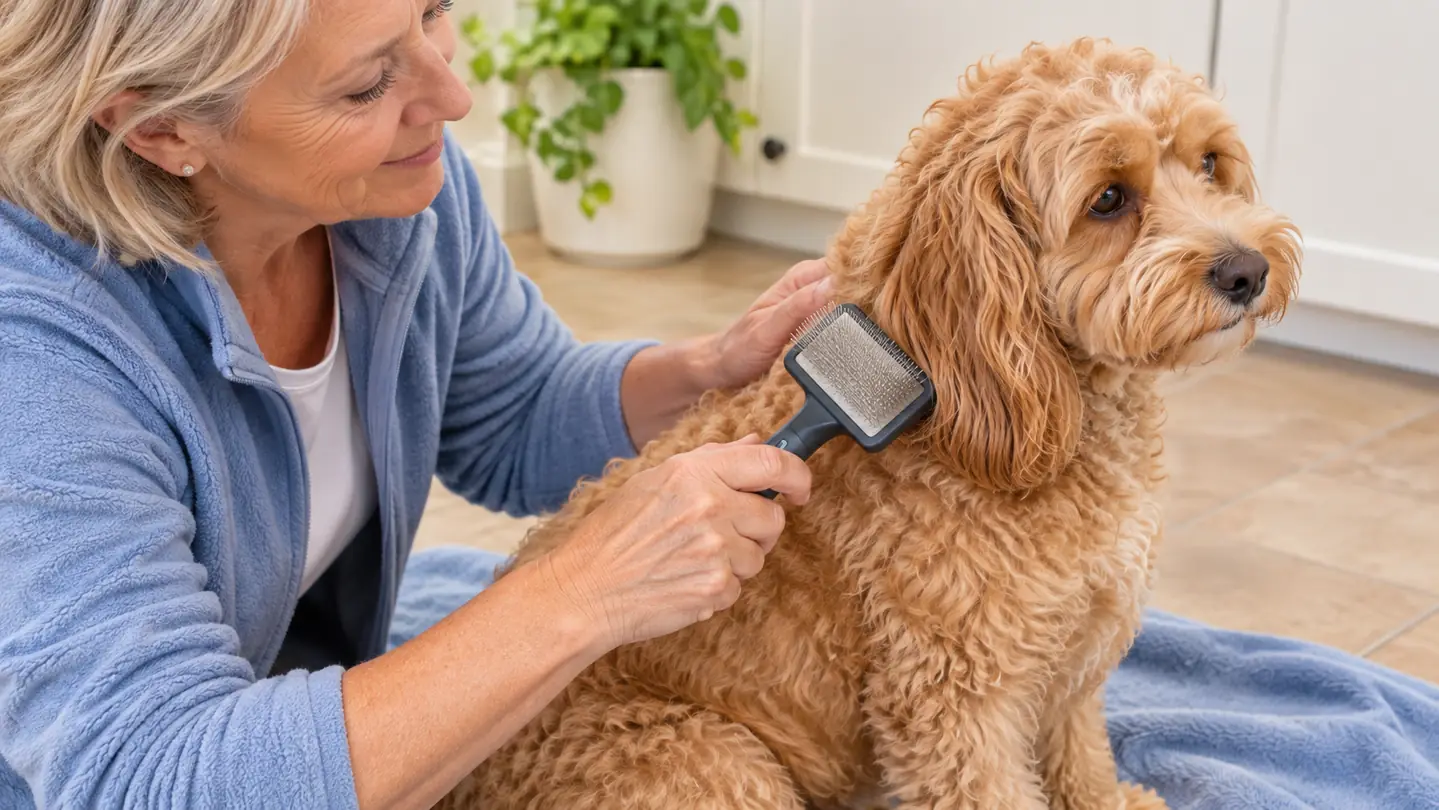
It is a small slicker brush. The head measures 3.25 by 7.25 inches and the whole thing weighs 0.96 ounces, about 27 grams, with a plastic handle and a rectangular head. The pins are wire and flexible, and each one carries a plastic tip. The listing describes it as a brush for small breeds and puppies, and the size bears that out. This is a tool that fits a hand and a small dog, not something you would reach for on a Labrador.
The plastic tips do more than they sound like they do. Bare wire ends scrape. On a dog with thin skin around the ears and in the armpits, scraping is the difference between a dog who stands still for grooming and a dog who leaves the room when the brush comes out. The listing also says the brush detangles fur, removes loose hair, smooths the coat, and helps spread the coat's natural oils evenly. The warranty line is a plain quality guarantee.
The shape of the head is worth a note as well. The Coastal Pet head is flat and narrow, so you can lay it against a curved surface like the side of a neck or the inside of a front leg and keep the pins in contact with the coat. A round or very wide head rocks off that curve and you end up brushing air while thinking you are brushing hair. That sounds like a small thing until you have spent a Sunday evening on it, and then it is the whole reason the tool works.
One limit worth saying out loud. The pins are flexible, not stiff, and they are not built to cut through a mat. A slicker brush lifts and separates hair that is still loose enough to be lifted. If a mat has already tightened into a lump, no brush on this page will fix it, and pressing harder with either one is how dogs learn to hate grooming.
The size cuts both ways, so it is worth being honest about it. A head this small means you brush in sections instead of sweeping across a back. On a 16 pound dog that is fine, and it is the reason the brush can get behind an ear at all. On a bigger dog it would be slow and fussy. The tool is not small because it is cheap. It is small because that is the job it was made for.
Where the Li'l Pals Slicker Brush Wins
It wins in the two places a Cavapoo mats first, behind the ears and in the armpits. The head is small enough to work in there without wrestling the dog's ear out of the way. On my dog the mats behind the ears were noticeably smaller about 5 weeks after I switched. By the second groomer visit after that, roughly 12 weeks in, Dana stopped mentioning mats at all. Nothing else in our routine changed during that stretch, which is why I credit the brush.
It also wins on comfort, and comfort is what keeps a routine going. Every pin has a plastic tip, so what meets the skin is not a bare wire end. That matters most when the person doing the brushing is an owner at the kitchen table and not a professional with a table and a loop. A brush that pulls once is a brush the dog remembers. A 0.96 ounce tool in the hand for 15 minutes is also nothing. My hand does not ache afterward, which is more than I can say for the old pin brush.
A pin brush glides across the top of a curl and leaves the mat forming underneath, where you cannot see it until it has tightened.
Where a Pin Brush Wins
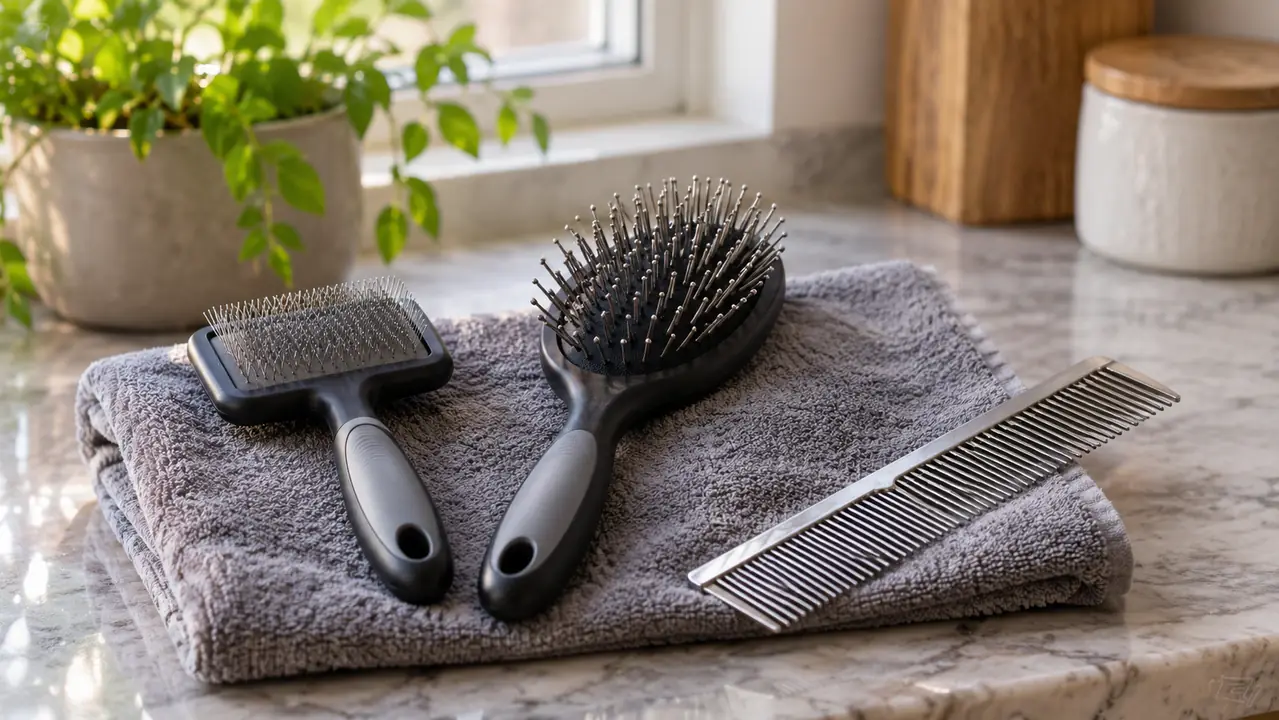
A pin brush is not a bad tool. It is the wrong tool for this job, and those are different things. Where it wins is coverage. A wide head covers more of a body in one pass, and on a large dog that is a genuine advantage. The pin brush I had was sized for a bigger dog and could sweep across a back quickly. The Li'l Pals head is built for small breeds, so brushing a 16 pound dog means working section by section. That is slower, and slower is a fair complaint to make about any grooming tool.
It also wins as a finisher. On a long, straight coat, a pin brush is what people reach for to smooth the hair and lay it down flat at the end of a groom. On a curly coat it does not do that, because there is no straight hair to lay down. And the honest concession on top of that: if you are brushing a big dog with a thick undercoat, the small slicker would wear out your patience long before it wore out the coat. Different dogs, different tools.
The Brush That Gets Under the Curl Instead of Across It
3.25 by 7.25 inches, 0.96 ounces, with a plastic tip on every flexible wire pin. This is the one that has lived in my kitchen drawer for about 14 months.
Amazon Check Today's Price on Amazon →How I Use Both on One Dog
The routine here is Sunday evening, about 15 minutes, before the ear cleaning. I work in sections with light strokes, then run a plain steel comb I already owned through the same section. The comb is the check. If it drags, I missed something and I go back over that spot with the brush. On Wednesdays I do a 2 minute check behind the ears and in the armpits, which catches trouble while it is still small enough to brush out. That midweek check is the part I would keep if I could only keep one thing.
The comb check is not a formality. A few Sundays back I finished the left side, told myself it was done, ran the comb through, and it stopped dead in the armpit. I went back in with the Coastal Pet brush in short strokes, a few hairs at a time, until the comb passed on the second try. If I had trusted my eyes instead of the comb, that spot would have been a mat by the following week and Dana would have had to take it out for me.
The pin brush still lives in the closet. Honestly, it comes out for nothing now. If you already own one, that is not a reason to skip the slicker, and if you are choosing between the two for a Cavapoo, the choice is not close. The slicker stays in the kitchen drawer by the back door, which is where a brush has to be if it is going to get used on a Wednesday when you are already tired.
What Neither Brush Fixes
Neither brush replaces the groomer. Dana does the bath, the trim, and anything that has tightened past the point where a brush can help, every 6 weeks. A brush bought to avoid that appointment will disappoint you. What the brush does is keep the coat from reaching the point where the appointment turns into a rescue. Dana can take a mat out and she has, but a coat shaved down to the skin takes months to come back and the dog looks different for a while. The point of a brush is to keep that from being the conversation.
Neither brush fixes a skin problem either. If the dog is chewing at one spot, or the skin under a mat is red or broken, that is a call to Dr. Reyes and not a change of grooming tool. And no brush makes a dog who dislikes being handled tolerate it. Short sessions, a treat afterward, and stopping before the dog has had enough will do more for you than any head shape or pin type.
What I Liked
- Gets under the curl instead of riding across the top of it
- A plastic tip on every wire pin, so nothing sharp meets the skin
- 3.25 by 7.25 inches is sized for a small dog and for the spots behind the ears
- 0.96 ounces, so 15 minutes of brushing does not tire the hand
- Pairs well with a plain steel comb as a check after each section
Where It Falls Short
- Too small to be quick on a large dog
- Will not remove a mat that has already tightened
- The pins are flexible, so heavy pressure can still scrape
- Not a finishing brush for a long, straight coat
Who Should Buy Which
Buy the Coastal Pet Li'l Pals Slicker Brush if you own a Cavapoo, a Cockapoo, a Maltipoo or another small curly crossbreed, and you are doing maintenance brushing between groomer visits. Buy it if the mats show up behind the ears and in the armpits before they show up anywhere else, because those are the two spots this head was shaped to reach. Buy it if your dog is small enough that a big brush feels clumsy in your hand and clumsy against his skin.
Buy a pin brush instead if your dog has a long, straight coat and you want a finishing brush, or if you are brushing a large dog and need coverage more than detail. Those are real jobs and a pin brush does them well. If you already own one and you also own a Cavapoo, keep it as a spare and add the slicker. The two do different work, and the work this coat needs is the small one with the coated tips.
If you are still unsure, do the cheap test. Run your fingers behind your dog's ears and into his armpits right now. If you find small lumps or a felted patch starting, you already have your answer. That is the layer a pin brush slides over and a slicker brush lifts out, and it is the layer that decides whether the next groomer visit is routine or a shave-down.
Fourteen Months, One Small Brush, Fewer Mats Behind the Ears
A small tool for a small dog. If your Cavapoo mats behind the ears and in the armpits first, start here, and let your groomer handle anything that has already tightened.
Amazon Check Today's Price on Amazon →