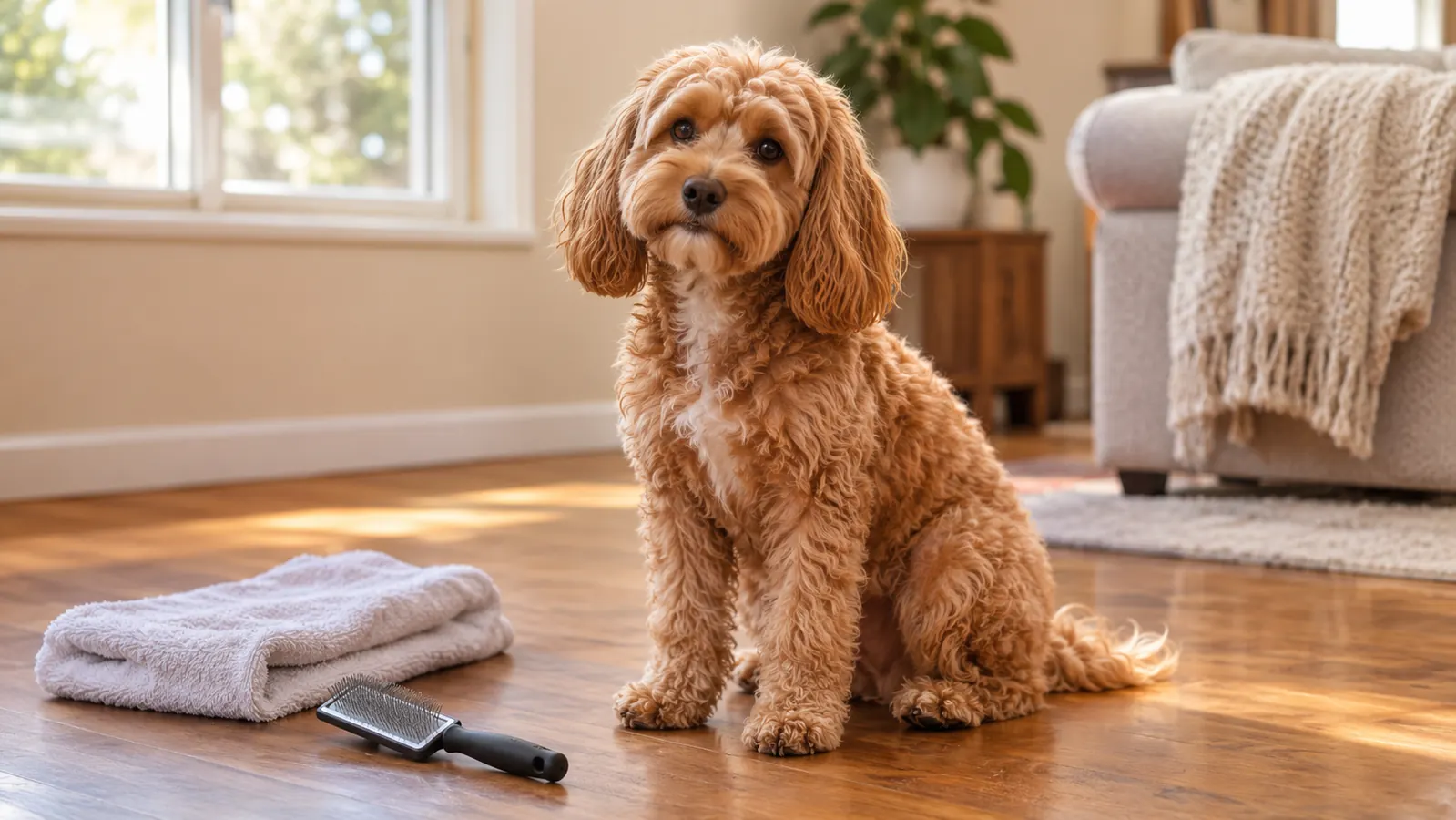
Wally has a spot behind his left ear that turns into a felt pad if I look away for ten days. He is four years old, sixteen pounds, and apricot curly from nose to tail, and for the first three years I owned him I thought a once-over with the pin brush from his puppy kit was enough. It was not. By the time Dana, our groomer, ran her hands over him at the six-week appointment, she would find a thumb-sized knot tucked under the ear leather and another in each armpit.
I am not a groomer. I am a retired school office manager outside Roanoke with one small dog and a hardwood floor that collects hair faster than I can sweep it. What I have is a routine that works between Dana's visits, and the tool at the center of it is the Coastal Pet Li'l Pals slicker brush. It has a rectangular head, wire pins with plastic tips, and a plain plastic handle. It is small enough to keep in the kitchen drawer by the back door, which is the only reason I use it as often as I do.
The brush that finally reached the mats behind his ears
The Coastal Pet Li'l Pals slicker is a small rectangular brush with flexible wire pins and plastic tips, sized for a sixteen pound dog. It is the tool I use every Sunday and the one I check the armpits with on Wednesdays. If your Cavapoo's coat looks smooth on top and knots underneath, this is the step you are missing.
Amazon See Today's Price on Amazon →Why the Pin Brush From the Puppy Kit Stopped Working
The pin brush from Wally's puppy kit was not a bad brush. It was the wrong brush for his coat. The pins were long, spaced far apart, and finished with little round balls. On a short coat they glide through. On a Cavapoo's curls they ride the top of the wave and never get down to the skin.
I would brush him for ten minutes on the living room floor and he would look smooth as a teddy bear. Then I would part the hair behind his ear with my fingers and find the same knot I had been feeling for a week. The pins had been passing over it, not through it.
The Coastal Pet brush is built differently. The wire pins are flexible and set in a rectangular head, and each one ends in a plastic tip. The pins give against the body instead of raking it. That flex is why I can use it in his armpits without him pulling away, and it is why the brush gets under the top layer of curl instead of skating across it.
There is one more difference, and it took me a while to see it. The head is small. A big brush encourages big sweeping strokes, and big sweeping strokes feel productive while doing almost nothing. A 3.25 by 7.25 inch head forces you to work in sections, which is the only way a curly coat actually gets brushed.
How to Stop Cavapoo Matting With a Slicker Brush
The order matters more than the effort. This is the Sunday routine in our house, about fifteen minutes, plus a two-minute check on Wednesday. If your dog is already matted to the skin, stop here and call your groomer. A brush is for maintenance, not for a coat that has already packed.
Step 1: Start With a Dry Coat and an Honest Look
Never brush a wet Cavapoo. Water tightens curl and makes a mat tighter against the skin. I brush Wally before his ear cleaning, not after, because the ear cleaner makes him shake his head and dampens the coat around his neck and shoulders.
Run your hands over the dog first. Feel behind both ears, under both front legs, around the collar line, and along the back of the thighs. If you find a knot bigger than a pea that will not pull apart with your fingers, do not put the slicker through it. Work around it and let the groomer take it out. Dragging a slicker through a tight mat hurts and makes the mat worse.
If the coat is dry and mostly free of knots, go ahead. A dog that has been out in Virginia humidity can have a damp undercoat even when the top looks dry. Give him twenty minutes inside with the ceiling fan on and a towel rub-down before you start.
Step 2: Work in Sections, Not All Over at Once
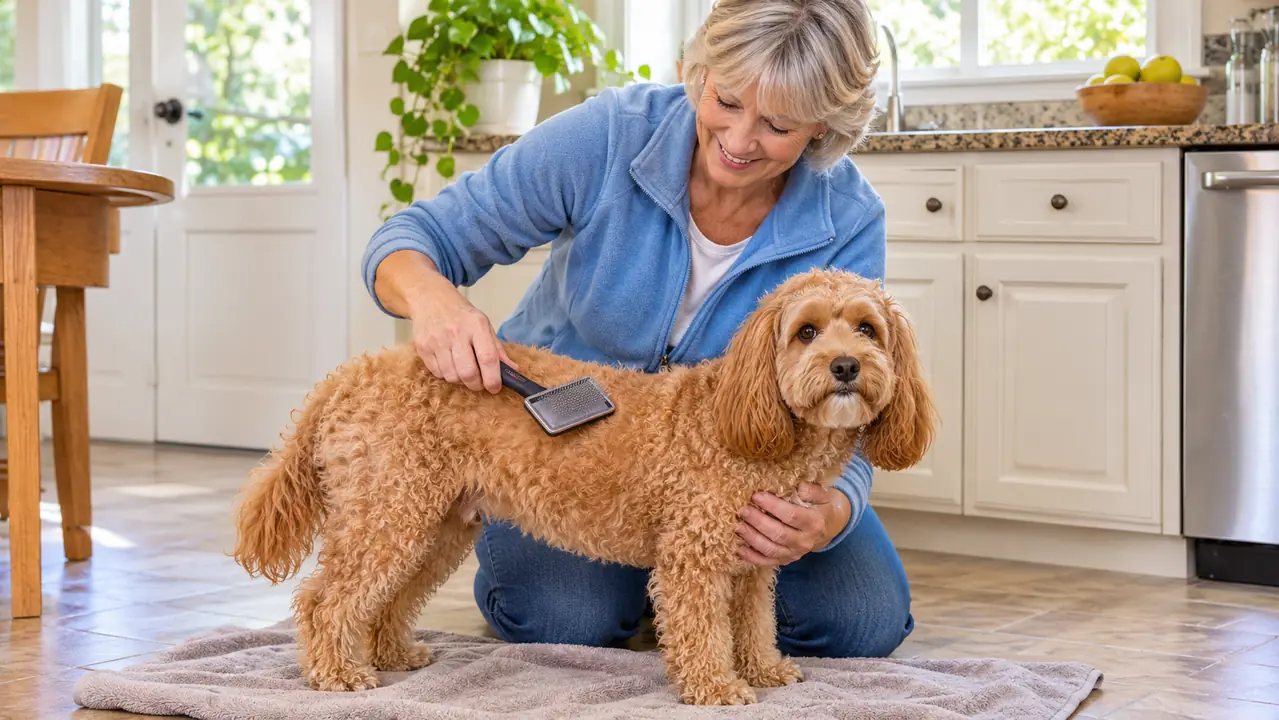
I start at the back of his neck and work toward his tail, then do the ears last. The ears are where he is most sensitive and where I need him still. The brush head is 3.25 by 7.25 inches, small enough to hold in one hand and angle behind an ear without bumping his eye.
Lift a section of coat with your free hand. Brush the surface in the direction the hair grows, let the section fall, then brush it again. On a Cavapoo, the difference between a glance and a real pass is whether you can see skin at the base of the part. If you cannot see skin, you are still on the surface.
Do one side of the dog, then the other. If you try to do the whole dog in one long sweep, you will lose track of the armpits. I know because I did. Now I do the left armpit, the left ear, then the right side, and I say it out loud to myself like a checklist.
Step 3: Use Light Strokes and Let the Coated Tips Do the Work
The pins on this brush are wire with plastic tips, and the tips are the part that matters. Press hard and the wire scrapes. Let the brush rest in your hand and use short, light strokes, the way you would dust a lampshade.
I hold the brush like a pencil, not like a scrub brush. Two or three inches of travel per stroke. The flexible pins follow the curve of his ribcage and the hollow behind his front leg instead of digging in.
Watch the dog's face. Wally will turn his head if I get rough, and that is my signal to lighten up. If your Cavapoo yelps, freezes, or tries to leave, you are pressing. Stop for the day and start again tomorrow. A bad brushing session sets you back a week because the dog remembers.
A slicker brush is not a groomer. It is the thing that keeps you from needing the groomer's clippers.
Step 4: Follow With a Plain Steel Comb to Check Your Work
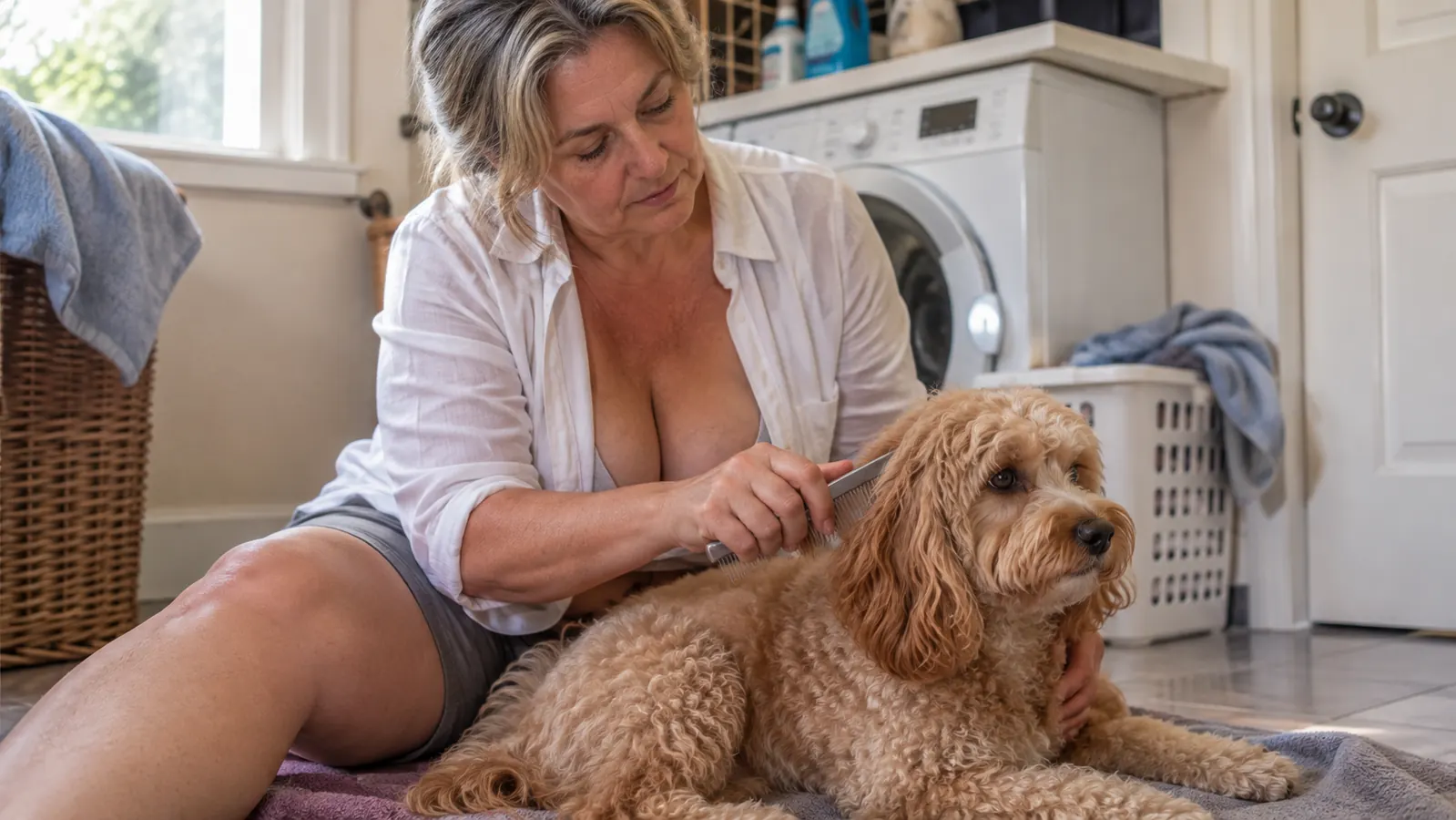
The slicker lifts loose hair and smooths the surface, but it can also make a coat look finished when it is not. I run a plain steel comb through each section right after the brush. The comb tells the truth.
If the comb glides through, that section is done. If it catches, there is a knot the brush passed over. Go back with the slicker, a smaller section, lighter strokes, then comb again. If the comb still catches after two tries, leave it for Dana.
The comb is also how I found the mats in the first place. A slicker alone would have let me believe the job was finished. The comb is the inspection, and the inspection is the part that keeps you honest.
Step 5: Keep a Two-Minute Check on the Hot Spots Midweek
On Wednesday, after our second walk, I run my fingers behind both ears and up into both armpits. Two minutes, no brush unless I feel something. If I feel a small knot starting, I use the slicker on that one spot for thirty seconds and comb it out.
This is the step that actually stopped the mats. Sunday alone was too late. Ten days of curl is enough time for a knot to tighten. Two minutes on Wednesday catches it while it is still separate-able with a brush.
The brush lives in the kitchen drawer by the back door, next to the leash. If it were in the bathroom cabinet I would not use it. Put it where you already stand.
About five weeks in, the mats behind his ears were smaller. By the second groomer visit after I started, about twelve weeks, Dana stopped mentioning mats. She did not congratulate me. She just moved on to the ears. That was the result I wanted, and it came from a fifteen-minute Sunday and a two-minute Wednesday, not from anything dramatic.
What Else Helps
Brushing is the floor, not the ceiling. Four other things made a difference in our house.
First, a six-week groomer schedule with Dana. I know that is not free, and I know some months it is inconvenient. Stretching to eight weeks was the difference between a brush maintaining the coat and a brush fighting a losing battle. If six weeks is out of reach, ask for a bath and a tidy between full grooms.
Second, getting the harness off when we come inside. The Kurgo Tru-Fit has straps that sit right in his armpits, and straps against curly coat rub it into mats. He wears it in the car and on walks, and it comes off in the laundry room.
Third, a bath every four to six weeks with a conditioner, not just shampoo, and a full dry. A damp undercoat that never dries is a mat waiting to happen. I bathe him a week before Dana, not the day before, so the coat has settled.
Fourth, a plain steel comb in the same drawer as the brush. The comb is the part that tells me whether I am done. If you buy one thing after the brush, buy the comb.
Sunday is also his ear night. I brush him first, then do the EpiOtic, because the ear routine makes him shake his head and I do not want to brush a damp ear flap afterward. If an ear looks red or smells wrong, that goes to Dr. Reyes, not to me and not to a brush.
Where the Coastal Pet Brush Falls Short
It will not remove a tight mat. If the knot is already felted against the skin, the brush will glide over it and you will think you have done something. Dana removes those with clippers, and she has my permission to take the coat shorter than I would like.
It is small. The 3.25 by 7.25 inch head is right for a sixteen pound dog and wrong for a Labrador. If you have a big doodle, this is not the tool for a fifteen-minute full-body session.
The wire pins can scrape if you press. The plastic tips help, but they do not make the brush foolproof. I learned that the first week, and Wally told me.
It does not replace the groomer, a bath, or a comb. It is one step in a routine, and it only works if the other steps happen too. I would rather say that plainly than have you buy it expecting it to do everything Danas hands do.
Who This Is For
This is for the owner of a small curly or wavy dog, sixteen to twenty-five pounds, who is already seeing a groomer every six to eight weeks and wants the coat to still look decent in week five. It is for someone who will keep the brush in a drawer they open every day and who will actually comb afterward. It suits a Cavapoo, a Cockapoo, a Maltipoo, or a small poodle cross with a coat that mats behind the ears and in the armpits.
Who Should Skip It
Skip it if your dog is matted to the skin right now. That is a groomer or vet appointment, not a brush. Skip it if you have a large doodle, a Golden Retriever mix, or a dog with a coat longer than your hand. The head is too small for that job and you will be there all afternoon.
And skip it if you are not going to comb afterward. A slicker without a comb is how I spent three years thinking I was brushing my dog when I was only brushing the top of him.
The small brush that made the six weeks between Dana's visits quiet
If your Cavapoo's coat looks smooth on top and knots underneath, start with the Coastal Pet Li'l Pals slicker and a plain steel comb. Brush on Sunday, check the hot spots on Wednesday, and let Dana handle anything that has already tightened. That is the whole routine in our house, and it is the first one that has held for more than a year.
Amazon See Today's Price on Amazon →