
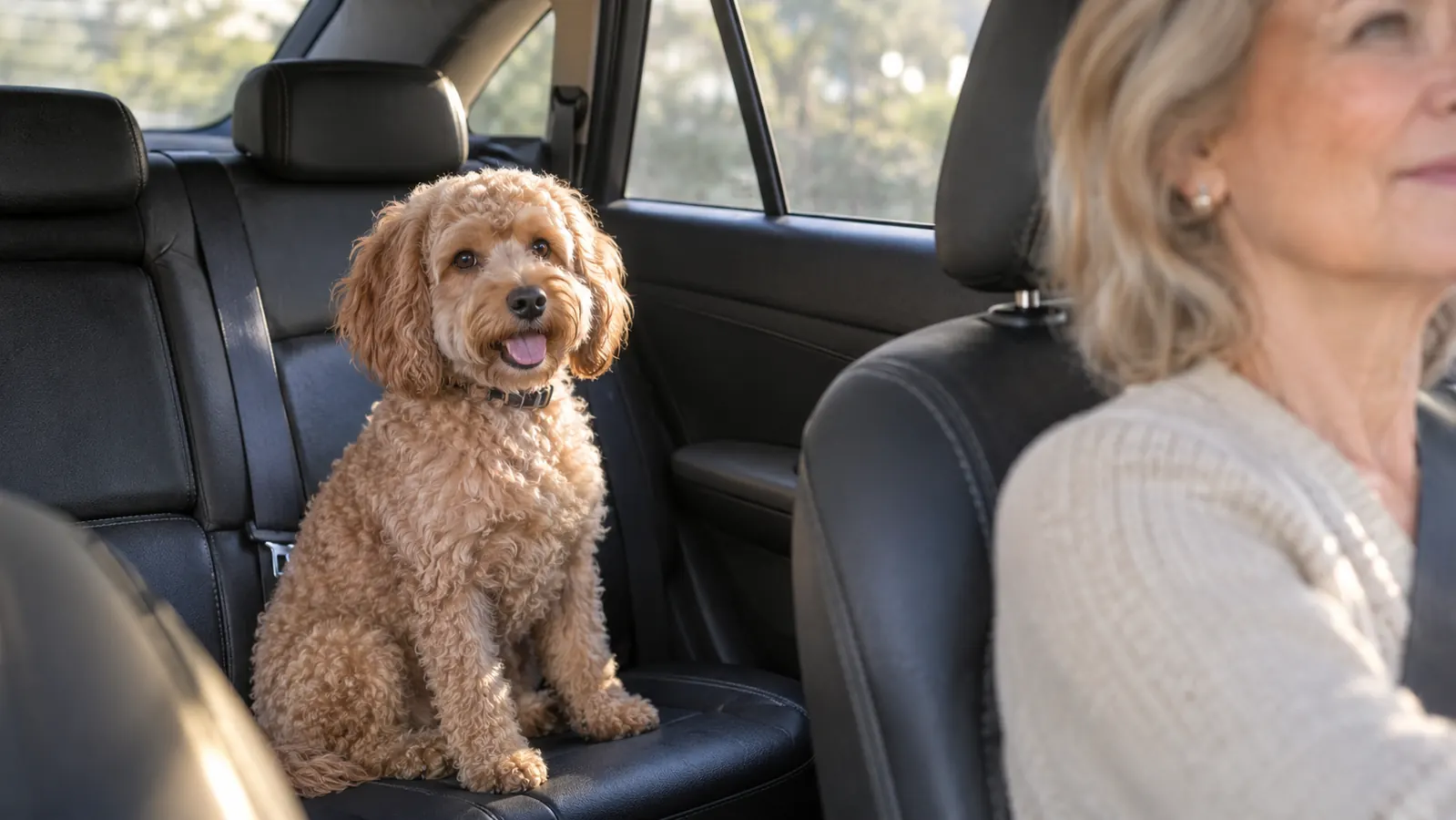
In March 2025 I braked hard for a deer on a county road near our house. Wally was on a blanket on the back seat, and he slid off and landed in the footwell. He was not hurt. He was shaken, and so was I. That week I ordered the Kurgo Enhanced Strength Tru-Fit Smart Harness in a small, and he has worn it on every car ride since. He is a 4-year-old Cavapoo, 16 pounds, and we have had the harness about 20 months. I am not a trainer or a vet. I am a retired school office administrator with one small dog and a 2019 Subaru Forester.
What follows is the routine we actually use. It is not the only way to keep a small dog safe in a car, and it is not a guarantee. It is five steps that took me two evenings and one loose fit to learn. If you have a Cavapoo or another small dog who rides loose on the back seat, this is where I would start.
The harness that kept him out of the footwell
If your dog rides loose on the back seat, start with the fit. The Kurgo Tru-Fit is the one Wally wears, and the tether comes in the box.
Amazon See the Harness on Amazon →What You Need Before Step One
You need the harness, the tether that comes in the box, your dog's chest measurement, and a few minutes in your own driveway. You do not need a special car seat or a crate, though either can be part of a safe setup. Wally uses the Kurgo as both his car harness and his walking harness. That is not required. It is simply what worked for us. A plain 6 foot leash and a collar with tags are the rest of his walking gear.
Step 1: Measure your dog and buy off the size chart
The Kurgo comes in sizes, and the chart is the only thing I trust for a first order. Measure the chest girth behind the front legs, all the way around. Write the number down and check it against the maker's chart. Wally measured into a small at 16 pounds, and that is the size he wears.
Do not size up for growth. A small dog is mostly grown by a year, and a loose harness is worse than a snug one. If the chart puts your dog between sizes, call the maker or ask your vet tech before you order. I would rather measure twice than drive with a harness that lets him shift forward in a stop.
The listing says crash test-certified. I take that as one more reason to fit it correctly, not as a promise that nothing can go wrong. A harness is a restraint. It is not a force field. We have not been in an accident with Wally in the car, and I hope that stays true.
Step 2: Fit it at home, not in the car
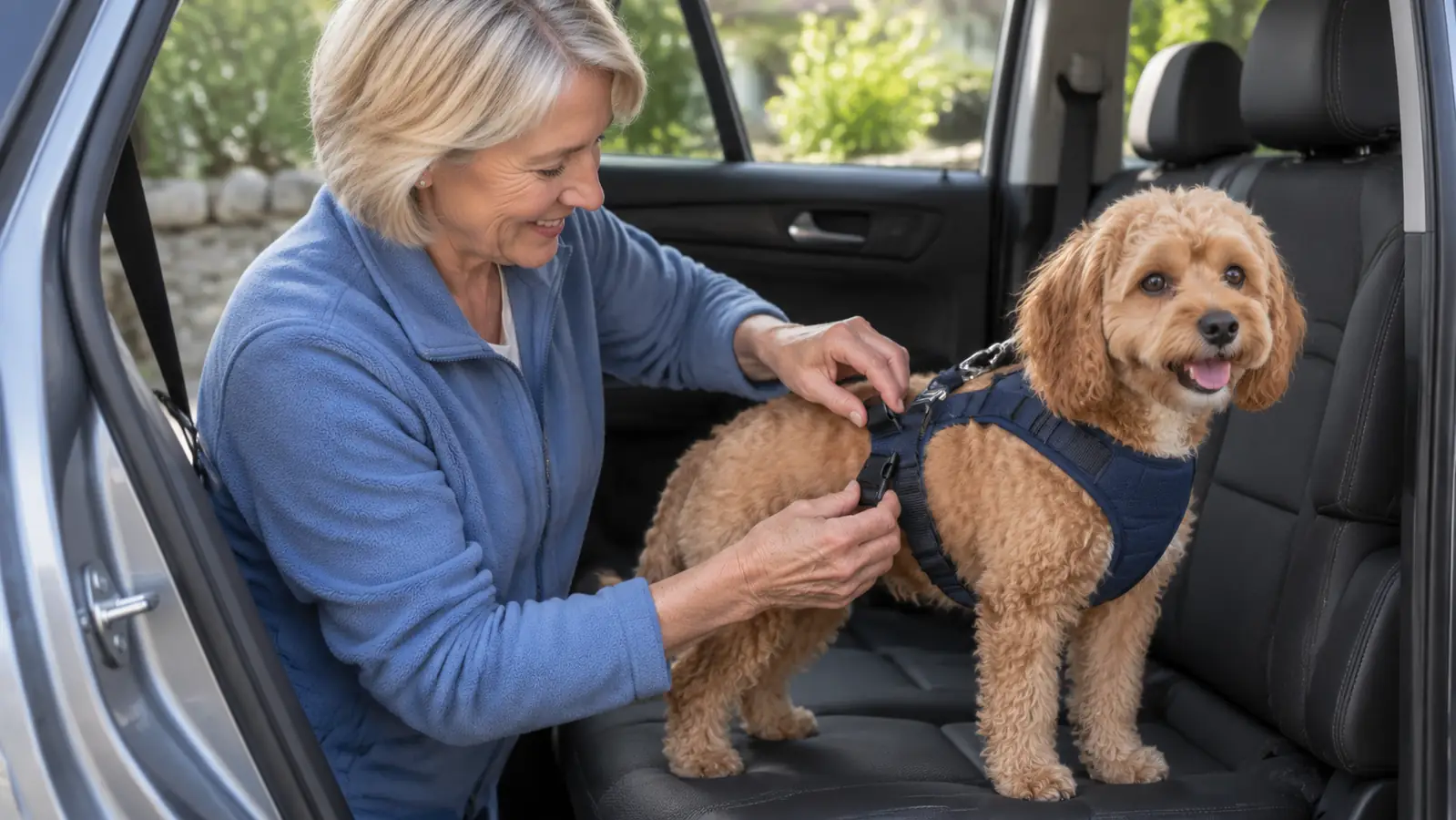
The harness has five points of adjustment and a padded chest plate. It took me two evenings to get it right. The first night I had the shoulders too loose, and he could back out of it in the living room. That is exactly the kind of thing you want to find out on the rug, not at a stop sign.
Start with the chest strap snug, then work around the body. You should be able to slide two fingers under a strap, not a whole hand. Check behind the front legs and under the chest for pinching. Have your dog stand, sit, and lie down while you watch. If a strap gapes when he sits, tighten that one a little.
The buckles are stiff. That is one of the tradeoffs. They loosen up with use, but the first month I needed two hands and a little patience. Put the harness on before you open the car door, not after. A dog who is already excited about a ride is not the best partner for a fitting.
Wally does not wear the harness in the house. Straps left on rub the armpit coat into mats, and his coat mats easily behind the ears and under the front legs. On goes the harness at the door, off it comes when we get home. If your dog has a thick or curly coat, check under the front legs after every ride for the first week.
Step 3: Put the dog in the back seat, passenger side
Wally rides in the back seat, passenger side, in the Forester. Never the front seat. The front seat has an airbag, and a small dog does not belong in front of one. The back seat also gives him a flat surface and a door that opens away from traffic when we park on the street.
I put an old towel on the seat. It is not a restraint, but it gives him something that smells like home and keeps the seat from being slippery. A back seat cover would do the same job. The point is to have him settle in one spot, not to let him pace from window to window. I also use the child safety locks on the rear doors so he cannot nose a window down or a door open.
At first he braced his front legs and would not lie down. I sat in the back with him for two short rides around the block. By the third ride he lay down on his own. If your dog will not settle, keep the first trips short and boring. A trip to the vet is not the first place to test a new harness.
He was unhurt that day. That was luck. The harness is the part I could control.
Step 4: Clip the tether to the seat belt
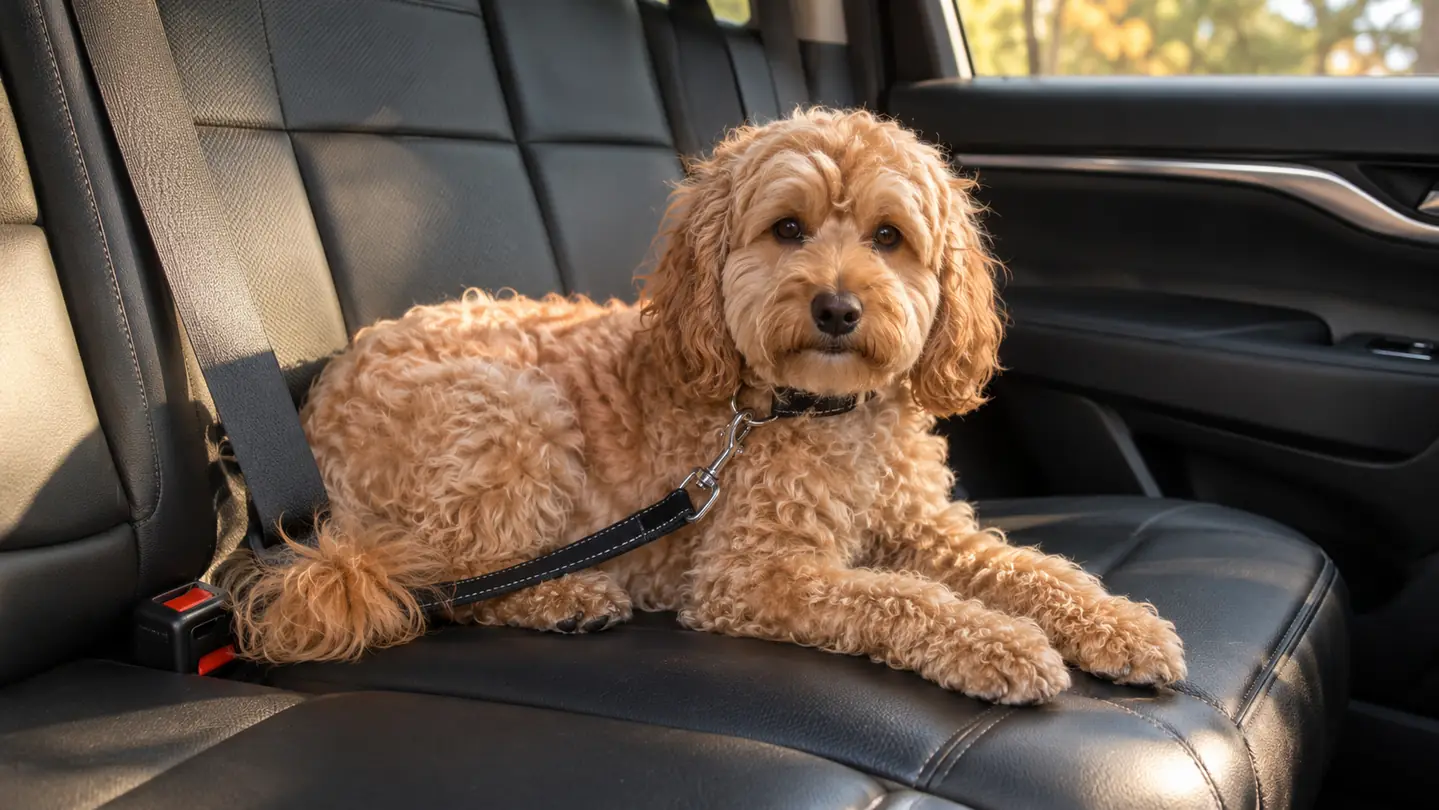
The box comes with a 10-inch seatbelt tether and a steel carabiner. I loop the tether through the seat belt and clip the carabiner to the harness. The tether is short on purpose. It lets him sit and lie down, but not reach the front seat or the door handle.
Do not clip a leash to his collar and call it done. A collar is for tags and a leash, not for holding a dog in a moving car. The pressure goes to the throat. The harness puts it across the chest, which is the whole reason we use one.
Check the connection every time. I tug the carabiner and the seat belt before I start the engine. It takes two seconds. I also check that the tether is not twisted and that the buckle is flat against the seat, not digging into him. If he has been chewing on the strap, look at it before you trust it.
On longer rides I stop every couple of hours and let him walk. He is 16 pounds and he does not need much, but a drink and a sniff keep him calm. I never leave him alone in the car with the harness on. The harness is for the ride, not for a parking lot.
Step 5: Make it a routine and wash it by hand
The harness lives on a hook by the back door. When I grab my keys, I grab the harness. Wally gets harnessed in the entryway, then we walk out to the car. The routine matters more than the gear. A dog who knows the order does not fight the straps.
The care label says hand wash only. I wash it in the laundry sink about once a month with a little mild soap, rinse it well, and hang it to dry. I do not put it in the dryer. The padded chest plate holds water, so I plan it for a day when we are not going anywhere.
At 16 pounds the harness is bulky. The buckles are stiff, and it is more harness than a short neighborhood walk needs. We use it anyway because it is the one that fits him and the one he knows. On a very hot day I keep the walks short and check under his front legs for rubbing when we get home.
Remember that the harness is also his walking harness. He wears it for two 20-minute walks a day on a plain 6 foot leash. That is not a car safety feature, but it means the fit gets checked twice a day. A strap that rubs on a walk will rub in the car. If you see a bare spot, stop using it and check the fit before the next ride.
How to Tell the Fit Is Wrong
A bad fit shows up in small ways before it shows up in a crash. Look for red marks or bare patches under the front legs. Watch for a strap that hangs loose when your dog sits. If he can back out of the harness while you hold the leash, it is too loose. If he grunts when he lies down, it may be too tight across the chest.
The five points of adjustment are there to fix those problems, but they only work if you take the time. Go through them again after the first week and again when the coat changes. Wally's coat is thicker in winter, and I let one strap out by a finger width in November. By spring it goes back. A harness that fit in July is not guaranteed to fit in January.
What I Would Do Differently
I would buy the harness before the deer, not after. That is the plain truth. I would also fit it on a Tuesday evening when neither of us was in a hurry, instead of the Saturday morning before a vet appointment. And I would write the chest measurement on the inside of the pantry door, because I have already forgotten it once.
I would not buy a second harness for walks. One well-fitted harness used for both jobs is easier to keep track of, and it gets checked more often. I would also keep the box and the tether together. The tether is the part that makes the car setup work, and it is small enough to lose in a drawer.
What Else Helps
The harness is the main thing, but it is not the only thing. Keep the rides short when you are starting out. Do not feed a big meal right before a long drive. Crack a window for air, and keep the dog on the passenger side, away from the traffic door. If your dog drools or vomits in the car, that is a vet conversation, not a harness problem.
A back seat cover or a towel helps a dog settle, but neither is a restraint. A booster seat is another option some small dog owners use. I have never owned one, so I cannot tell you how they compare from experience. I can tell you that a loose dog on a blanket is not safe, and that is what we had before the harness.
If your dog is anxious about the car, the harness will not fix that. It keeps him in one place. It does not teach him to relax. We used short practice rides and a radio left low at home for a different worry, and that is a longer story. For car anxiety, ask your vet or a trainer who uses positive methods. The harness is a seat belt, not training.
If you use a different car, check the seat belt and the tether before you put the dog in. Seat belts sit at different heights, and a tether that works in one car may pull at a bad angle in another. It takes a minute to adjust. I check the angle every time I buckle him in, even in our own car.
One last thing, and it is the least technical part. Wally still does not love the car. He tolerates it. The harness means I am not watching him slide around while I drive, and that alone changed how I feel on the road. If your dog is small enough to fit on a blanket, he is small enough to slide off one. That is the whole reason I wrote this down.
Fit it in the driveway, not on the road
Measure the chest, order off the chart, and give yourself two evenings to adjust the straps. That is the whole job. The Kurgo Tru-Fit is the harness Wally has used for about 20 months.
Amazon See the Harness on Amazon →