
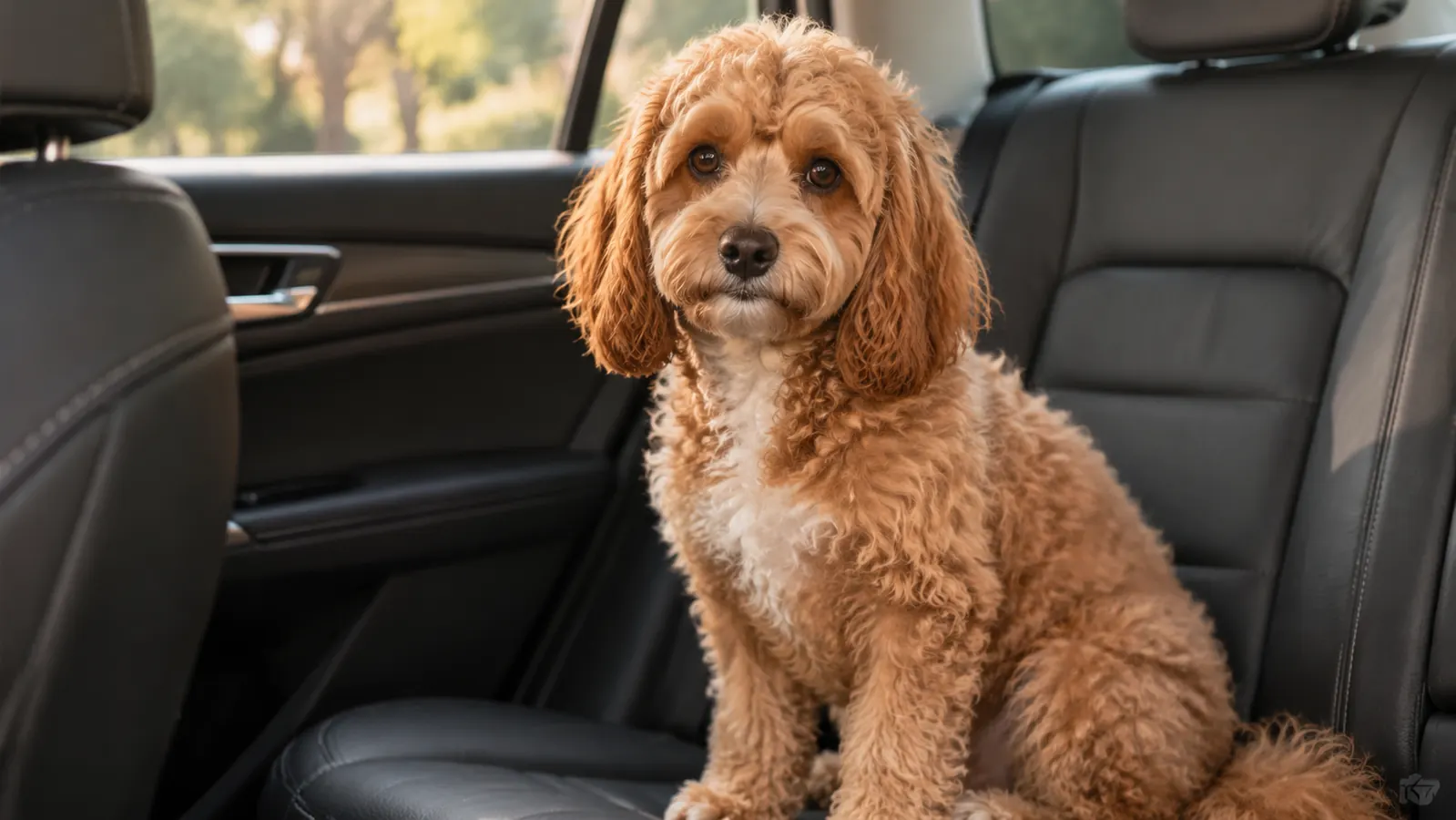
Wally is 16 pounds of apricot curls and, for the first year and a half I had him, he rode on a blanket on the back seat of my Forester like a sack of groceries. I will tell you exactly what changed that. In March 2025 I braked hard for a deer on a county road near the house and he slid off the seat into the footwell. He was not hurt. He was shaken, and so was I. I ordered the Kurgo Tru-Fit Smart Harness in a Small that week, and he has ridden clipped to the seat belt ever since.
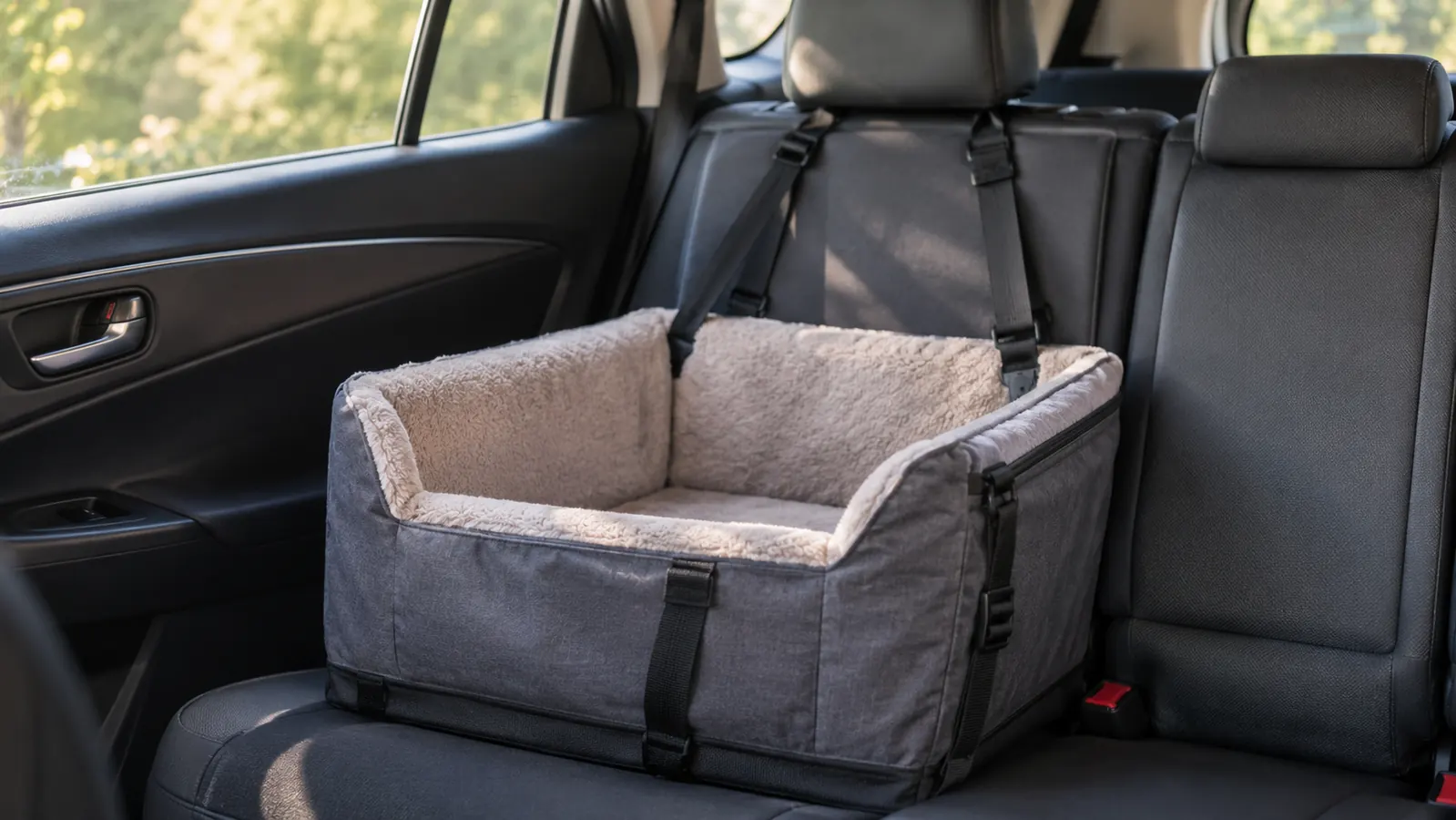
The other option people ask me about is a booster car seat, the raised kind that straps onto the back seat so a small dog can ride up at window height. I have never owned one. I have stood in the aisle at the farm store and looked at three of them, read the boxes, and talked to two people who use them. So this is one owner's comparison rather than a test: what the harness does, what a booster does, and which one makes sense for a 16 pound dog whose main trip is four miles to the vet and back.
| Kurgo Tru-Fit Harness | Booster Car Seat | |
|---|---|---|
| Restraint | Buckles onto the dog and clips to the seat belt with a 10-inch tether and a steel carabiner | The dog sits in the raised seat and clips to a short strap inside it |
| Crash testing | The listing says crash-test certified | I did not find that claim on any of the three boxes I read in the store |
| Fit on a 16 pound dog | Small, five points of adjustment and a padded chest plate, and it is still a great deal of harness on a small frame | Made for small dogs, and the dog sits in it rather than wearing it |
| Seeing out the window | He rides at seat height, which is not window height | The entire point of it, the dog is raised up to the window |
| Room on the back seat | Comes off in the doorway, so the seat still takes passengers | Stays strapped in and claims a seat of its own |
| Moving between cars | Goes in a tote bag with the dog, nothing to unstrap | Unstraps and re-straps every time, and it is awkward to carry |
| Use away from the car | Also his walking harness, two 20 minute walks a day | Not made for walks |
| Cleaning | Hand wash only in the laundry sink, air dried overnight | The cover lifts off and the frame wipes down |
| Best for | A dog that rides often and also walks on a harness | A calm small dog on short trips who wants the view |
Where the Kurgo Harness Wins
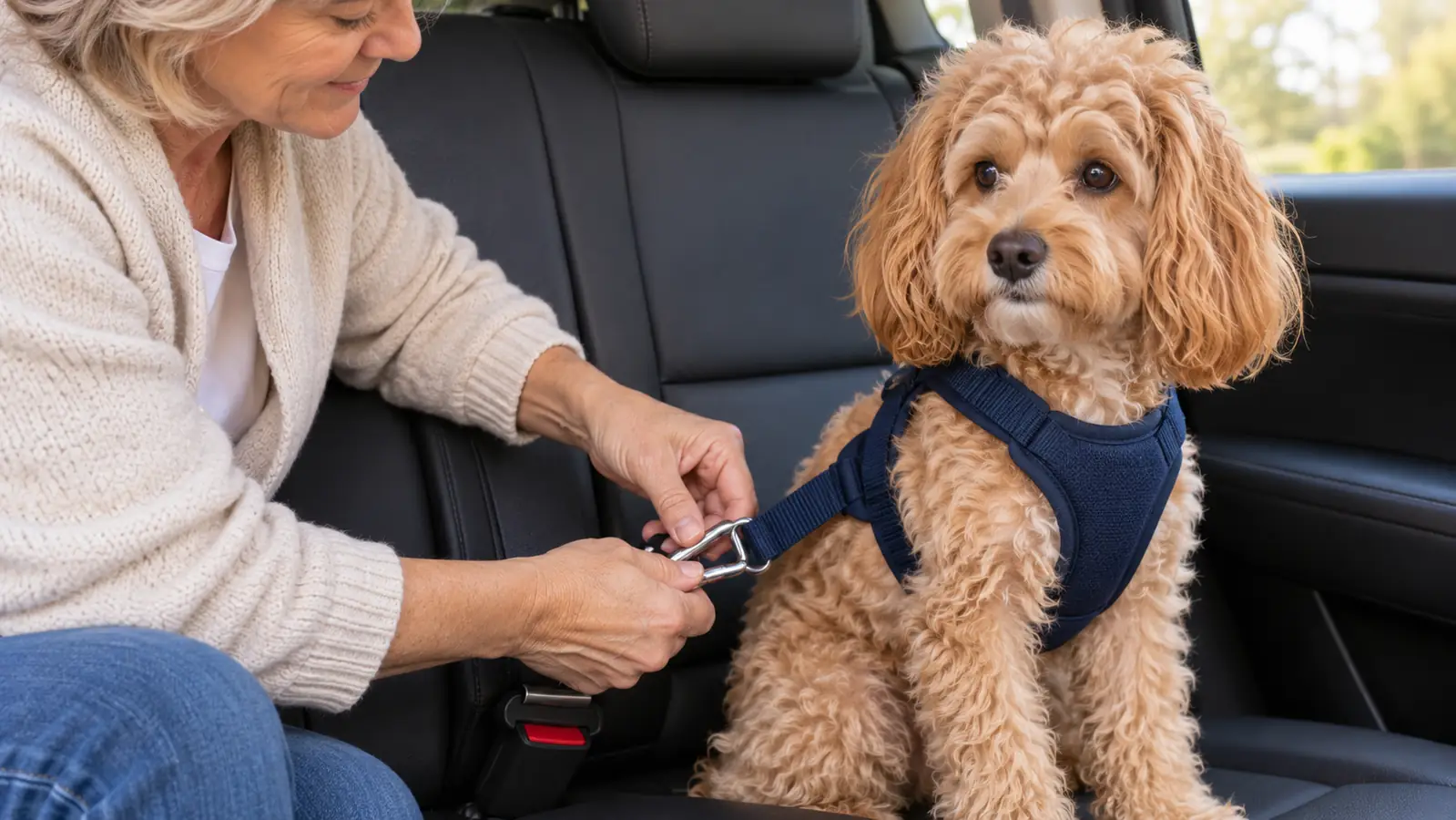
The first thing, and the reason I bought it, is that it holds him. It buckles on, and the 10-inch seatbelt tether with its steel carabiner clips the harness to the seat belt itself. He can sit, stand, turn around and lie back down, and he cannot leave the seat. On a four mile trip to the vet that is the whole job, and it is a job the blanket never did.
The second is that the listing says crash-test certified, and that is as far as I am willing to take it. I am not a crash tester. I have never had an accident with Wally in the car, and the harness is not a promise that nothing bad will ever happen. What I can tell you is that Kurgo put that claim on the box, the webbing is heavy enough that it does not fold over on itself when I pick the harness up by one strap, the closure is a buckle rather than a plastic snap, and after 20 months of daily use nothing on it has stretched or frayed. I have run my thumb along the stitching at the chest plate more than once looking for a loose thread and have not found one. The booster seats I handled in the store did not carry that claim. I read all three boxes, front and back, and asked the woman working the aisle, and she could not point me to one either.
Third, it is not furniture. The harness comes off in the doorway when we get home and hangs on the hook by the back door. The back seat goes back to being a back seat, with room for a passenger or a bag of potting soil. A booster stays strapped in, which means one of the two seats behind me is spoken for from the day you install it. And when we take my sister's car, the harness goes with us in a tote bag. There is no seat to unstrap, carry out and strap in again.
Where a Booster Seat Wins
I will be honest with you, on a 16 pound dog this harness is a lot of hardware. Small is the size and it is correct per the maker's chart, but on Wally it comes up over the chest and around behind the elbows like a piece of equipment rather than a strap. Getting the five points of adjustment right took two evenings, with Wally standing on the kitchen floor and Tom feeding him biscuit crumbs while I moved one strap at a time and then put the whole thing back on him to see where the chest plate landed. The first evening I had it too loose across the chest and he walked straight out of it in the driveway. The second evening the chest straps went in a notch and sat right, but it took me three tries on the straps behind his elbows before he stopped standing there like a statue, which is how a dog tells you it is too tight. A booster seat asks none of that. He gets in, sits down, and clips to a short strap, and nothing has to be fitted to his body because nothing is on his body.
The view is the other real advantage, and it is not a small one. Wally rides at seat height and mostly sees the back of my head. A dog in a booster sits up near the glass and can watch the world go by, and the two people I talked to both said the change in their dog was mostly about that. If your dog gets carsick, or whines from the driveway to the end of the street, a better view is worth taking seriously. My dog was not carsick. I had the version of the problem where he could slide off the seat, so that is the version I solved.
And they are easier to clean, from what I could see. My harness is hand wash only, so about once a month I fill the laundry sink, wash it by hand, and hang it to dry overnight while Wally gives me a wounded look from the kitchen. The boosters in the store had covers that lift off and frames that wipe down with a cloth. That is not nothing in a car that also carries a curly dog.
If your dog can slide off the seat, this is the fix I actually bought
Small, five points of adjustment, a padded chest plate, and a 10-inch seatbelt tether with a steel carabiner in the box. It is also his walking harness, so it earns its hook by the door instead of sitting in the car.
Amazon Check today's price on Amazon →What You Get in the Box, in Plain Terms
One harness. That is the entire contents list. In practice that means a webbing harness with a padded chest plate, five points of adjustment, buckle closures, a 10-inch seatbelt tether and a steel carabiner. The maker's lifetime warranty is stated on the box, which I have not had to test and hope not to. The material is listed as alloy steel, which refers to the hardware rather than the straps. Hand wash only, and they mean it.
The Kurgo size chart says the Small covers dogs up to 75 pounds. I read that twice. On 16 pounds of dog it is a bulky fit and I have said so, but it also means I am not going to be told in a year that the harness has gotten too small. That was not my reason for buying it. It is the reason I have not had to buy a second one.
The one thing I would tell a friend is to measure the dog and use the maker's chart rather than guessing from a photo of a labrador wearing one. That is what the two evenings were about, moving the adjustment points a notch at a time with Wally standing on the kitchen floor and Tom holding a biscuit. If you cannot be bothered with that part, the harness will rub, and the rubbing is what turns the armpit coat into mats.
Twenty Months Later
He has worn it for two 20 minute walks a day around the neighborhood on a plain 6-foot leash, plus every car trip on the passenger side of the back seat, never the front. It comes off when we get home. That is not tidiness, that is coat care. Straps left on a curly dog rub the hair under the front legs into mats, and a mat is a groomer problem, not a harness problem.
It has been washed in the laundry sink about once a month and air dried, because the care label says hand wash only and that is not a suggestion. The webbing has faded a little across the top of the chest plate from the sun coming in the back window. The buckles are still stiff, which is my main daily complaint: on a cold morning in January I need two hands and a knee to hold him still, and Wally is 4 and has opinions about standing in the driveway when there is a squirrel in the hedge. Tom does it faster than I do and he knows it.
The other honest thing is that this is more harness than a short walk needs. If we only walked around the block, a plain walking harness would have done the job and I would not have bought this one. The car is what justified it. The walking is what makes it worth keeping rather than leaving in the car to be forgotten.
Twenty months, two walks a day, one hard brake for a deer, and the webbing and the hardware have not given me a reason to look at anything else.
Do You Need Either One?
Most dogs do not ride enough to need a car seat of any kind. If Wally went to the vet twice a year and nowhere else, I would have put a crate in the back and been done with it, because a crate does the same job and you may already own one. What made the difference here was the volume. Groceries, the groomer every 6 weeks, the vet, my sister's house on Sundays, and two walks a day that keep the harness on and off the hook anyway.
A crate, a harness and a booster do the same basic job, which is keeping the dog from turning into something loose in the car when you stop short, and not one of them is a guarantee. That is the part I would want a friend to hear from me rather than from a box. If you are choosing between these two and your dog is small and calm, the honest answer is that a booster is easier on everybody and the harness is the more cautious choice. I picked the harness because I had just watched my dog leave the seat, and because one harness covers the car and the walk. If that near miss had not happened, I might have bought a booster and never thought about it again, and my dog would have been fine, because most days nothing happens.
Who Should Buy Which
Buy the harness if your dog rides loose and you have already had the moment I had, or you would rather not wait for it. Buy it if your dog also walks on a harness, so the thing lives by the door and gets used twice a day. Buy it if you still want the back seat for people. Do not buy it because the listing says crash-test certified and treat that as the end of the question about your dog's safety in a car. It is one claim on one box and I am in no position to verify it. I can tell you the webbing is heavy and it has held up, and that after 20 months the only thing I have had to replace on it is nothing.
Look hard at a booster if your dog is small, calm, and unhappy in the car in the specific way that a better view fixes. Look at one if your dog is older and standing for a whole trip has become work, since a booster is a seat and not a garment. Look at one if the seat it goes on is already the dog's seat and nobody else uses it. And if your dog rides twice a year to the vet and you have a crate that fits him, skip both. A crate is not nothing.
The harness I would buy again, and the reason is the deer
Small, five points of adjustment, a 10-inch seatbelt tether and a steel carabiner. Hand wash only. It goes on in the driveway and comes off at the door, and it has done both for 20 months.
Amazon Check today's price on Amazon →