
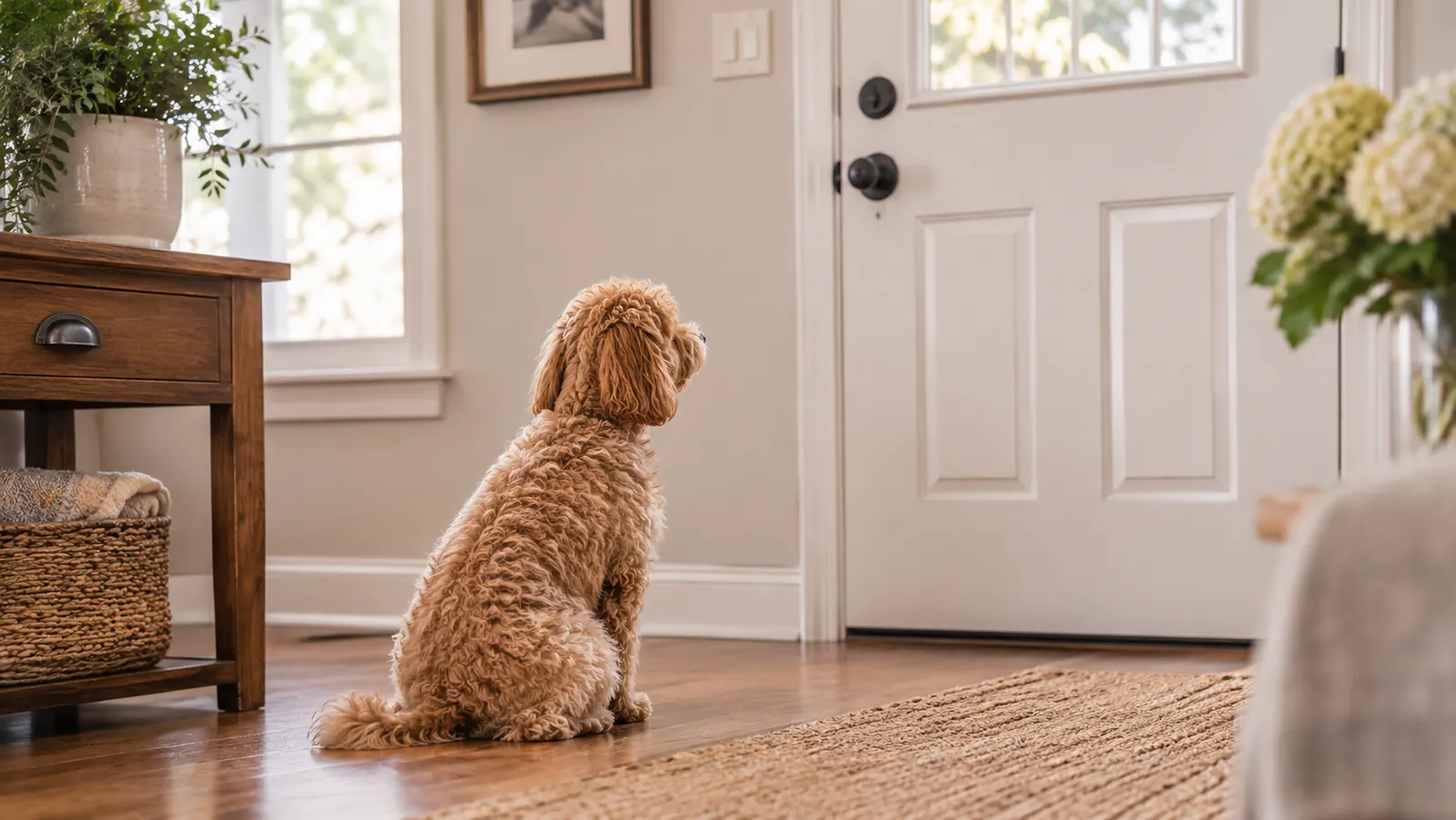
The first time I set up an old phone to record the front door while Tom and I went out to breakfast, I expected to see Wally sleeping. He is a 4-year-old Cavapoo, 16 pounds, and he had been fine, I thought, every time we left. What the phone showed was forty minutes of him pacing from the door to the hallway and back, whining at a pitch I had never heard from him in the house. He did it in loops. Door, hallway, the corner of the rug, back to the door.
That was the first week of October 2025. What follows is the order I actually fixed it in, which is not the order I expected. I started with the leaving itself, not with a supplement, and I only added Purina Pro Plan Veterinary Diets Calming Care after Dr. Reyes suggested it in January. Ten months later he settles in about ten minutes instead of thirty. He still whines first. That part has not gone away and I am not going to tell you it will.
The powder that went on his breakfast, not in his mouth by force
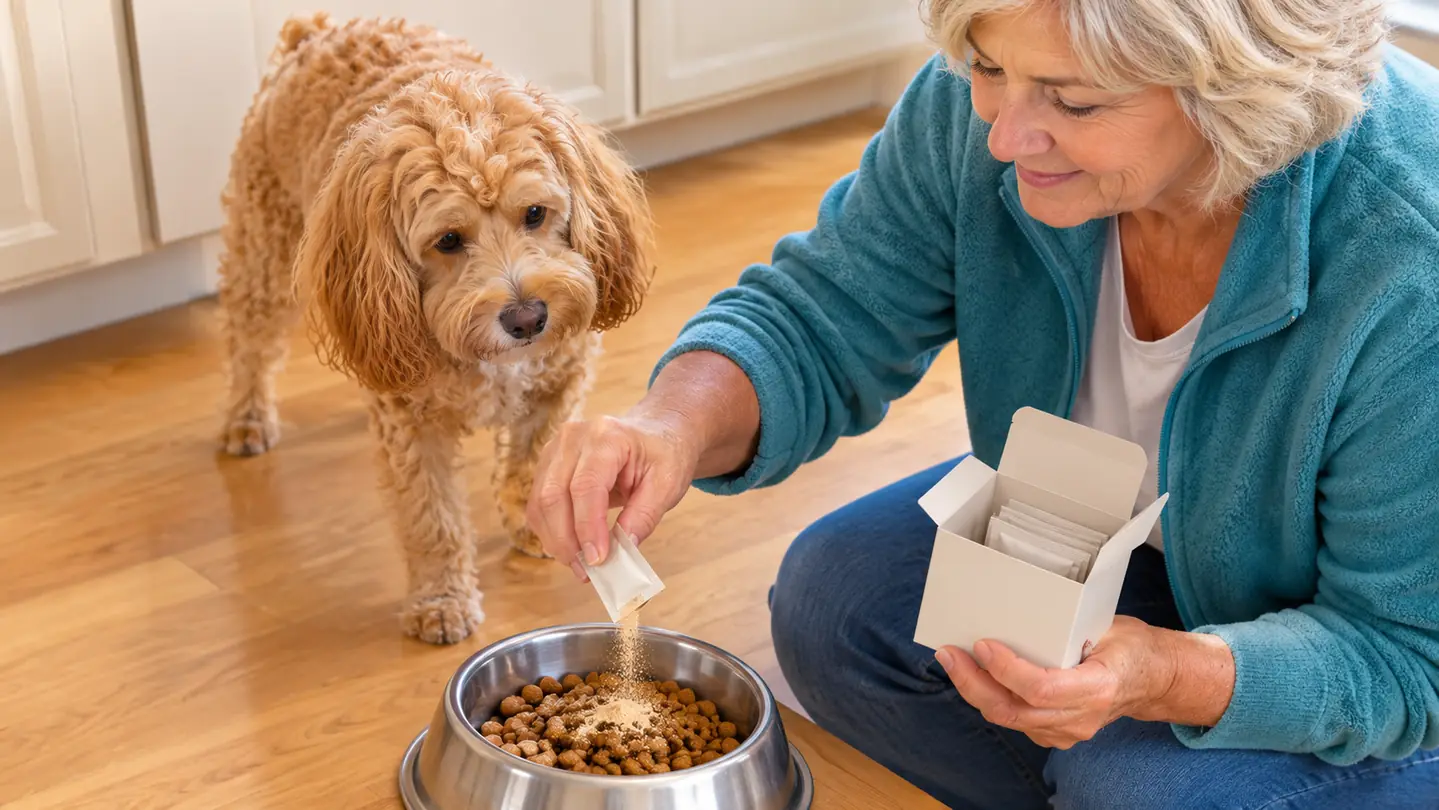
Calming Care is an unflavored powder in single packets, one a day, sprinkled on kibble. It took about six weeks before I saw anything. If you want the short version of what ten months of daily use looked like, it is written up on its own page.
Amazon See the 10-month Calming Care notes →Step 1: Rule out the boring causes before you call it anxiety
A Cavapoo who paces when you leave is not automatically an anxious dog. Some of them are bored, some are underslept, and some are telling you they need to go out forty minutes after you last took them. Dr. Reyes asked me three questions before she would talk about behavior at all: how much exercise he got in a day, whether he was being left right after a meal, and whether the whining had ever come with drooling, damage, or an attempt to get out of the house. I answered all three sitting on the end of an exam table with Wally on my lap.
The last question matters most. Pacing and whining that stops is one thing. A dog who salivates heavily, chews a door frame, or hurts himself trying to get through a window is a different problem, and it needs a veterinarian and probably a behaviorist, not an article from a retired school office worker in Virginia. I want to be clear about where my experience ends. Wally never damaged a thing. He fretted. Those are not the same size of problem and I would not want you to treat them as though they were.
What we changed first cost nothing. His second walk used to happen at half past four, about an hour before we would leave for the evening. We moved it to five fifteen and walked him after his dinner instead of before it, which meant he was out the door on a full stomach and tired, rather than hungry and watching us gather our things. We also stopped leaving within twenty minutes of his breakfast, because he would still be licking the bowl when the door closed. That alone cut the whining from forty minutes to under thirty. Not a fix. A trim. But it was the first number I had written down that went in the right direction.
Step 2: Practice the leaving in pieces too short to be scary
The trainer we spoke to once, on the phone, told me to stop thinking of it as leaving and start thinking of it as a hundred tiny rehearsals. Wally's trigger was not being alone. It was the sound of keys, then the front door closing, in that order. So for two weeks I picked up my keys, sat back down on the couch, and did nothing else. Then I put my hand on the door, opened it, closed it, and stayed inside. He watched me from the rug the whole time with his head tilted.
Then I stepped onto the porch for ten seconds. Then thirty. Then I got in the 2019 Subaru Forester in the driveway and sat in it without starting the engine while Tom watched through the living room window. The first time I actually drove around the block he was at the door when I pulled back in, but he was not whining, and that was already a change from the week before. We built up over about three weeks to a full four minutes of me being genuinely gone, which felt absurd at the time and was the single most useful thing we did. By the third week he was not waiting at the door when I came back in. He was on the rug with his chin down.
The rule I would pass on: never go further than the last successful step in one day. If he whines at thirty seconds, tomorrow you do twenty. Write it down or you will not remember where you stopped, and the temptation to push ahead is strong because the early steps feel silly. This is slow and it is boring and it works better than anything else on this list.
Step 3: Leave something on so the house is not silent
Wally is an only dog, which I did not think mattered until I heard the recording. An empty house is acoustically different from a house with one person in it. Every car door on our street, every creak in the hallway, every delivery truck at the neighbor's came through clear as a bell, and each one restarted him. In the recording you can hear him stop whining, listen, and start again three seconds later.
We put a small radio on a low shelf in the living room, tuned to a talk station, volume low enough that I have to lean in to hear it from the kitchen. Not music. Voices. The point is not to entertain him, it is to fill the gaps between sounds so nothing startles him into alert. It stays on whenever we leave and it has stayed on for ten months. I unplug it rather than switching it off, so the click of the switch is not the last sound he hears.
Two things I would not do again. I would not leave the television on, because ours has a bright screen in a dark room and it made him sit and stare at it rather than settle. And I would not use a crate for this unless he already loves his crate. Closing a door on a dog who is already worried about being closed away from you is not a kindness, and a Cavapoo who has never been crated will spend the first hour working at the latch instead of resting.
He still whines for the first few minutes. What changed is that he stops, and the stopping used to take half an hour.

Step 4: Add the supplement, and give it six weeks before you judge it
In January 2026 Dr. Reyes suggested Purina Pro Plan Veterinary Diets Calming Care. I want to be honest about my frame of mind. I had already tried a tub of store-bought soft calming chews in 2024, for about a month, and seen nothing except that he picked around them and left the sticky bits on the floor. So I was not expecting much from a powder either.
It is not a chew and not a pill. It is an unflavored powder in single packets, thirty to a carton, and one packet goes on his breakfast kibble once a day, never more than that. The carton sits in the pantry beside the kibble so I do not forget it. It is a probiotic, and the packet lists Bifidobacterium longum BL999 at 1x10^9 CFU. He has never once refused it, which is more than I can say for the chews. There is nothing to pick around. It disappears into the kibble, and by the time he has finished the bowl you would not know it had been there.
Nothing happened for two weeks. I nearly stopped, and I said as much to Dr. Reyes at his checkup. She reminded me that Purina Pro Plan Veterinary Diets Calming Care is a probiotic, not a sedative, and that nothing about it is meant to work in an afternoon. Around week six I noticed the recording showed him settling at about the ten-minute mark instead of thirty. Not on the first try and not every day, but the bad days got further apart. Because I was doing the practice departures and the radio at the same time, I cannot tell you which of the three did the work, and anyone who tells you they can separate those out from one dog is guessing.
Step 5: Keep the return boring and the absences short
The hardest habit to break was my own. I used to come in the door and make a fuss of him, which felt kind and was teaching him that my arrival was the most exciting event of the day, which made the waiting worse. Now I come in, put my bag down, hang up my coat, and say hello in about the same voice I would use to greet the mailman. He gets a proper hello two minutes later, once I am in the kitchen and he has followed me there.
The second half of that is length. Four hours is our ceiling and we have only tested it a handful of times. Beyond that we take him to Tom's sister's house or we do not go. A dog who is managing his worry is not the same as a dog who can do a full day alone, and I would rather plan around the limit than spend the next year finding out exactly where it is. That is not defeat. That is knowing your dog.
If you take one thing from this step, take the boring return. It costs nothing, it needs no equipment, and it is the only one of the five that produced a visible change inside a week.
What Else Helps
Exercise before you leave, not after. A twenty-minute walk around the neighborhood with a few sniffs at every mailbox does more for a 16-pound dog than a longer walk taken at a brisk pace, because the sniffing is the part that settles him. Tired plus calm is the state you want him in when the door closes. A dog who has not been out of the house is neither tired nor calm, and no supplement is going to fix that.
A worn T-shirt of mine in his bed made a small difference for the first hour or so. Not a fix, and I would not spend money on it. Leave something you have actually slept in, and skip anything sold as a pheromone spray until your vet tells you otherwise. I have no experience with those and I am not going to pretend I do.
And keep a log for two weeks. Not a fancy one. I wrote the date, the time we left, the time we got back, and what the recording showed, all on one line. After a fortnight I could see that the bad days were all days when we left within an hour of a walk ending, or left without the radio on. Patterns you cannot see from memory you can see from nine lines on a notepad by the phone.
One more thing worth saying plainly, because it took me months to accept it. Short absences are not a lesser version of the real thing. They are the real thing, practiced at a size he can handle. The four-hour stretch only became possible after a few hundred two-minute ones, and if I had spent those months waiting for a long trip to prove something, we would still be where we started.
If it does not move in eight weeks, or if it is getting worse, that is a conversation with your vet about a behavior referral. Not a different supplement. There are medications for this and there are trainers who specialize in it, and neither one is a failure on your part. This routine is what worked on one dog in one house outside Roanoke. It is not a protocol and I would not want anyone treating it like one.
Ten months of daily packets, one honest write-up
One powder packet on breakfast kibble, once a day, no more than that. It took about six weeks before I saw anything, and I say so in the full review along with everything that did not change.
Amazon Read the full Calming Care review →